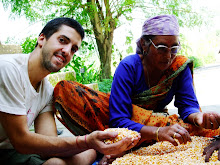
Damn, all this Quinua and Potatoes has made me strong!
Read More......
Wednesday, April 22, 2009


Terraces of Macchu Pichu
I loved closing my eyes and imagining what they looked like filled with potatoes, Quinua, corn, oca, ulluco, etc.
Read More......

Read More......
Salkantay Trek
Arriving at Macchu Pichu early in the morning after a damn hard climb up! Truly magical!
Read More......

Read More......


Salkantay Trek
My second favorite thing in the world behind seeds is mountains (an music)!
Read More......

Read More......
Mara - Andean Biodviersity
This is a photo of a few of the products which Mara is making in order to promote and protect Andea Biodiversity. They primarily work woith Andean grains - Quinua, Kiwicha (amnaranthus caudatus), and Kanihua. They also work with Andean tubers, fava beans. and corn. On top os their research and product development they also help with government nutrition and school lunch programs. Their is so much potential for these crops!
Read More......

Read More......
Moray - Incan Terraces
This is an amazing ancient Incan Site. After much research it is believed that these terraces were used as an agricultural experimentation for the Incans. Seeds were brought from around the Andes and were tested and acclimatized here. It is an incredibly intricate building and truly awe-inspiring to see how much work the Incans put into developing their agricultural technology. You can really feel the temperature difference between the top and the bottom and the different sites! There is also a great amount of symbolism and spirituality associated with this site.
Read More......

Read More......
9 Month Report!
Hello all!
Pasted below is my 9 month Watson report. Surprisingly, the Watson staff loved this report.
For those of you who read the manifesto below, this report is similar to that but with a bunch of additions. I was in a rush so much of it was copy and pasted. Hope you all are well! Adam
9 Month Report
It is a calm rainy morning in Cusco, Peru. The coca tea warms my throat and the Andean rain brings a feeling of freshness to the world. Once again, I am amazed that another three months has passed. Time has flown by, but it seems like ages ago when I wrote the last report in a crowded Bangkok restaurant. Since then I have been in Ethiopia, Canada, and Peru following my dream around the world. I left the states only 9 months ago a confused college graduate. My passion in life was certain, but I still struggled to figure out how I fit into this crazy world. Since then I have seen 6 new countries and travelled to many places I never dreamed of. Put plainly, my life has revolved around seeds: their propagation, importance, diversity, power, symbolism, meaning in different cultures, and use. The hope I have found through the seed-saving movement worldwide has been the core of my year and is something I could write for days about. I often feel like I’m overflowing with hope and respect for the power held in a seed.
However, the Watson Fellowship is about so much more than just my research. These 9 months of independent travel have given me a chance to step back and examine what my life is about. I have come to see that we learn the most through challenges. If I had simply stayed with my friends in the USA I would be comfortable and happily settled now. Instead, I have been immensely challenged both emotionally and physically. Giving up practically everything you know and love to travel the world alone is not an easy thing to do. There are times when I felt so alone it seemed as if no one in the world even knew I existed. Oddly, these feelings often came when in a city surrounded by millions of other people. Nights alone in Addis Ababa were tough as I couldn’t eat dinner without having crowds stare, beggars followed me at each turn, and young men tried to sell me anything you could imagine. I was a white face in a sea of black faces, unable to speak the local language.
There were other times I felt so constantly bombarded by people I desperately wanted to just run away and scream at the top of my lungs. There were also nights when I cried myself to sleep after hours of explosive diarrhea and vomiting (I never knew it was possible to do both at the same time!). I have spoken with farmers dying of malaria and felt children pulling on my pants to get just a piece of my bread. Through these challenges and many more I have been pushed to reexamine what my boundaries are. I have become comfortable in my own skin and have learned what it means to feel strongly out of place. Most powerfully, I have come to see the many similarities between peoples and cultures around the world. I now believe John Steinbeck was right when he said that we don’t have our own soul, but just a small piece of the much larger soul of humanity.
My journey has led me to gain a deep respect and appreciation for the human spirit in its many forms. I have shared laughs with chemical salesmen, beggars, elite landowners, scientists, farmers, racists, and everyone in between. I still subconsciously judge people based on the way in which I was raised, but now really enjoy looking past individuals harsh exteriors to see their human spirit shining within. We all are yearning to live a happy life, eat good food, find love, and gain some sort of respect or admiration. Our values and ways of living are defined in very different ways. However, there is a similar thread which links us all together on this crazy rock we call earth. This realization came to me one day in a busy market in Ethiopia. I was forced to sit down and laugh hysterically. All of a sudden, as I stared out at the mob of faces I saw that we were one and the same! I felt the anger of a drunken man inside me as he yelled uncontrollably. I saw myself in the rich businessmen pushing their way through the crowd and I felt the hunger of a desperate beggar deep in my stomach. Colors and defined faces faded away. They were replaced by a blurred mix of love, hate, devotion, dreams, and desires. Since then, I have felt content to stop searching for some huge esoteric meaning to life.
I am beginning to embrace to simple honesty of who I am. Throughout my whole life I have spent insane amounts of energy trying to impress others or define myself in relation to those around me. I was never cool per say, but I was the “compost man”, the “garden manager”, the club president, the environmental activist, etc. I hid my negative qualities and strived for some image of what I thought I should be – something that people would love and respect. Well, this year I have been away from all those who love and respect me. As a result, I have seen that I don’t have to work to impress people, it’s more important to be happy and healthy.
Many of the places I have visited this year have taught me that life is simpler than we have made it. Basic happiness is as much a part of living as any “success” we have been trained to strive for. I have become confident that I will never change the world. An individual can only do a small bit, but through our connections the actions ripple out and affect many others. Perhaps it is more important to live each day to the fullest, be joyous, and give respect to those around you than to work constantly to change the world. Life is fleeting at best and we must enjoy each minute we are given on this wonderful planet. After years of being fed depressing information on globalization and the state of our world, I have now benefited immensely from the globally connected nature of our planet.
The diverse people I have connected with \have shown me what it means to live a good life. We will never go back to some ideal simple existence that may have existed in the past. However, we will continue to grow and adapt (like our local seeds). The universal nature of humanity will shine on as it has for so many generations. In times of need, leaders will step forward and movements will spread. I do not believe humanity is on a course destined for destruction. This is one possibility, but there is another path I see. Communities around the world will unite and develop local solutions to solve our many problems. Once again, food will be seen as essential to culture and life. Authentic diversity will spread and remind us all what it means to be connected to a place. We will harvest the power of the sun, create urban farms, invest in children instead of war, and learn from each other through mutual respect. Yes, this is an ideal dream. Nonetheless, this possibility is just as possible as worldwide destruction is! I am not saying all will be perfect. This year has taught me to be happy with imperfection and to embrace uncertainty. Armies will fight, lovers will come and go, money will be lost, land will be destroyed, and sickness will spread. But, I believe in the end we will recognize the power of food, community, and the basic necessities of life.
The Ethiopian people have shown me that there is no reason to live without hope! I stayed in areas in which farmers had faced two wars, droughts, and famines. However, they still celebrated their coffee ceremonies, danced together, relished good food, and laughed over local liquors. Hope shines in the eyes of Ethiopian farmers who trade seeds and develop new varieties which adapt to their land. It shines in the Thai children as they show me their school gardens, the happy seed sellers in Canada, the resilience of the Dukhobor community in British Columbia, and in the mountain villages that keep our ancient diversity alive. Around the world people are uniting in their awakening that we cannot continue “business as usual.” They are not just sitting back and complaining about all that’s wrong with the world. They are uniting to work for a positive solution that enables us to live a joyous life.
Ethiopia was a month filled with crop diversity, cultural diversity, passionate farmers, skipping with children, some vomiting, and plenty of good laughs with fellow seed savers. I was challenged on many levels, but left the country even more motivated and inspired than when I arrived. Through my travels and many interviews I have seen that diversity in crops is directly linked with health and diversity of human cultures. The crops and their resilient seeds have co-evolved with the cultures and eco-systems of their respective regions. When we lose crop varieties from a region this is not just a biological loss, but a loss of cultural systems, human livelihood, and farmers freedom. We lose not just an inventory of plant materials or genes, but an incredible storehouse of knowledge of how to grow and use the plants. The knowledge comes as a result of generations of men and women experimenting, selecting crops for their diverse needs, building on the knowledge on their forefathers, and passing the skills to their children. Each farming family has diverse criteria they use to determine how to spread their risk, produce enough food on marginal conditions, and satisfy local cultural needs.
Our food today did not just appear in the wild, it exists because of the hard work of so many farmers. Ethiopia is a center of crop diversity for durum wheat, barley, sorghum, coffee, and chickpeas. For years we have taken seeds from these people to develop our modern agriculture. Now, many are fighting to keep the seeds in farmer’s hands. The Ethiopian famers blew me away with their agricultural practices and complex local seed systems. In a country where nearly 90% of the population is farmers, agriculture is the central part of life. The power of farmer’s ancient knowledge can be seen quite evidently in an Ethiopian highland field with its extremely infertile, dry rocky soil that is filled with a diversity of colorful crops. These crops satisfy families nutritional, economic, gastronomic, alcoholic, and spiritual needs. Other tourists I met in Ethiopia could only talk about the extreme poverty and flies on children’s faces. However, the memories that stick out in my mind are of colorful dances, joyous families, and diverse fields. Ethiopia showed me once again how important diversity and seed saving is not just for survival, but also for community sufficiency and the enjoyment of life.
As a whole, the past 3 months were especially educational for me because I experienced so many drastic transitions. Flying straight from Ethiopia to Canada threw my body and emotions upside down. My first night in Vancouver I woke frequently to dreams of dry Ethiopian fields. For days I relished the hot water and flushing toilets, but felt disgusted by the excessive consumption. People fought in Addis Ababa over 5 cent bread while people in Canada dropped 8 dollars on a beer or 25 dollars on a breakfast. How can we explain these extreme differences? Why are some born with so much privilege while others are born with nothing? How can so many of the rich be mean and unhappy while many Ethiopian villagers in mud huts can be so kind and joyous? These questions and my withdrawal from Ethiopian coffee left me sleepless for days. However, I was cheered up my first weekend in BC by Victoria’s Seedy Saturday (nearly 2,000 people in attendance).
Seedy Saturdays began twenty years ago in Vancouver. The idea of the event was to bring together people from various fields to work together for the common goal of conservation of open pollinated seed. There are now over 70 Seedy Saturdays or Sundays in Canada and the idea has even spread to Britain. In my month in Canada I got to attend six Seedy Saturdays. At first I was very confused over how to apply all the lessons I learned this year to North America. However, I was continually inspired by the local food and local seed movement in Western Canada. The concept of food security is taking North America by storm and awareness is spreading to the issue of seeds. At each event I interviewed seed sellers, chatted with gardeners, swapped seeds and shared stories of my travels. Aside from attending these amazing events I lived with a passionate seed saver and gardener who runs “Seeds of Victoria.” She reminded me of the importance of seed diversity for gardeners in North America and taught me how to run a small-scale seed business that benefits the local food system. Other seed sellers like Dan Jason inspired me with their stories of community seed banks and small-scale grain growing. During my last week in Canada I travelled to the Kootenays where I learned about the Russian Dukhobor community and their heritage seeds. I also spoke at two seedy events and people were very inspired.
In my first three weeks in Peru I have gotten tours of the Centro Internacional de Las Papas, visited many markets, tasted potatoes prepared in ways I never dreamed of, frolicked through Quinoa fields, and learned about the massive amount of native crop diversity here in the Andes. Once again, this locally adapted crop diversity is very important for marginal farmers because of their adaptability, pest and disease resistance, consistent yield without expensive inputs, taste, and balanced nutrition. The range of colors and varieties of potatoes in one field is truly astounding. There is beauty, health, and stability in diversity.
The farmers and activists I have met continue to show me that the power is in our hands to make change for the better. Yes, there are challenges. However, there are no excuses as to why we can’t keep our hope alive. The future is ours to grab and I see mine filled with seeds, healthy food, dance parties, friendship, love, and community. I do not need to change the world, I just need to improve the lives of some around me and have fun while doing it. Read More......
Pasted below is my 9 month Watson report. Surprisingly, the Watson staff loved this report.
For those of you who read the manifesto below, this report is similar to that but with a bunch of additions. I was in a rush so much of it was copy and pasted. Hope you all are well! Adam
9 Month Report
It is a calm rainy morning in Cusco, Peru. The coca tea warms my throat and the Andean rain brings a feeling of freshness to the world. Once again, I am amazed that another three months has passed. Time has flown by, but it seems like ages ago when I wrote the last report in a crowded Bangkok restaurant. Since then I have been in Ethiopia, Canada, and Peru following my dream around the world. I left the states only 9 months ago a confused college graduate. My passion in life was certain, but I still struggled to figure out how I fit into this crazy world. Since then I have seen 6 new countries and travelled to many places I never dreamed of. Put plainly, my life has revolved around seeds: their propagation, importance, diversity, power, symbolism, meaning in different cultures, and use. The hope I have found through the seed-saving movement worldwide has been the core of my year and is something I could write for days about. I often feel like I’m overflowing with hope and respect for the power held in a seed.
However, the Watson Fellowship is about so much more than just my research. These 9 months of independent travel have given me a chance to step back and examine what my life is about. I have come to see that we learn the most through challenges. If I had simply stayed with my friends in the USA I would be comfortable and happily settled now. Instead, I have been immensely challenged both emotionally and physically. Giving up practically everything you know and love to travel the world alone is not an easy thing to do. There are times when I felt so alone it seemed as if no one in the world even knew I existed. Oddly, these feelings often came when in a city surrounded by millions of other people. Nights alone in Addis Ababa were tough as I couldn’t eat dinner without having crowds stare, beggars followed me at each turn, and young men tried to sell me anything you could imagine. I was a white face in a sea of black faces, unable to speak the local language.
There were other times I felt so constantly bombarded by people I desperately wanted to just run away and scream at the top of my lungs. There were also nights when I cried myself to sleep after hours of explosive diarrhea and vomiting (I never knew it was possible to do both at the same time!). I have spoken with farmers dying of malaria and felt children pulling on my pants to get just a piece of my bread. Through these challenges and many more I have been pushed to reexamine what my boundaries are. I have become comfortable in my own skin and have learned what it means to feel strongly out of place. Most powerfully, I have come to see the many similarities between peoples and cultures around the world. I now believe John Steinbeck was right when he said that we don’t have our own soul, but just a small piece of the much larger soul of humanity.
My journey has led me to gain a deep respect and appreciation for the human spirit in its many forms. I have shared laughs with chemical salesmen, beggars, elite landowners, scientists, farmers, racists, and everyone in between. I still subconsciously judge people based on the way in which I was raised, but now really enjoy looking past individuals harsh exteriors to see their human spirit shining within. We all are yearning to live a happy life, eat good food, find love, and gain some sort of respect or admiration. Our values and ways of living are defined in very different ways. However, there is a similar thread which links us all together on this crazy rock we call earth. This realization came to me one day in a busy market in Ethiopia. I was forced to sit down and laugh hysterically. All of a sudden, as I stared out at the mob of faces I saw that we were one and the same! I felt the anger of a drunken man inside me as he yelled uncontrollably. I saw myself in the rich businessmen pushing their way through the crowd and I felt the hunger of a desperate beggar deep in my stomach. Colors and defined faces faded away. They were replaced by a blurred mix of love, hate, devotion, dreams, and desires. Since then, I have felt content to stop searching for some huge esoteric meaning to life.
I am beginning to embrace to simple honesty of who I am. Throughout my whole life I have spent insane amounts of energy trying to impress others or define myself in relation to those around me. I was never cool per say, but I was the “compost man”, the “garden manager”, the club president, the environmental activist, etc. I hid my negative qualities and strived for some image of what I thought I should be – something that people would love and respect. Well, this year I have been away from all those who love and respect me. As a result, I have seen that I don’t have to work to impress people, it’s more important to be happy and healthy.
Many of the places I have visited this year have taught me that life is simpler than we have made it. Basic happiness is as much a part of living as any “success” we have been trained to strive for. I have become confident that I will never change the world. An individual can only do a small bit, but through our connections the actions ripple out and affect many others. Perhaps it is more important to live each day to the fullest, be joyous, and give respect to those around you than to work constantly to change the world. Life is fleeting at best and we must enjoy each minute we are given on this wonderful planet. After years of being fed depressing information on globalization and the state of our world, I have now benefited immensely from the globally connected nature of our planet.
The diverse people I have connected with \have shown me what it means to live a good life. We will never go back to some ideal simple existence that may have existed in the past. However, we will continue to grow and adapt (like our local seeds). The universal nature of humanity will shine on as it has for so many generations. In times of need, leaders will step forward and movements will spread. I do not believe humanity is on a course destined for destruction. This is one possibility, but there is another path I see. Communities around the world will unite and develop local solutions to solve our many problems. Once again, food will be seen as essential to culture and life. Authentic diversity will spread and remind us all what it means to be connected to a place. We will harvest the power of the sun, create urban farms, invest in children instead of war, and learn from each other through mutual respect. Yes, this is an ideal dream. Nonetheless, this possibility is just as possible as worldwide destruction is! I am not saying all will be perfect. This year has taught me to be happy with imperfection and to embrace uncertainty. Armies will fight, lovers will come and go, money will be lost, land will be destroyed, and sickness will spread. But, I believe in the end we will recognize the power of food, community, and the basic necessities of life.
The Ethiopian people have shown me that there is no reason to live without hope! I stayed in areas in which farmers had faced two wars, droughts, and famines. However, they still celebrated their coffee ceremonies, danced together, relished good food, and laughed over local liquors. Hope shines in the eyes of Ethiopian farmers who trade seeds and develop new varieties which adapt to their land. It shines in the Thai children as they show me their school gardens, the happy seed sellers in Canada, the resilience of the Dukhobor community in British Columbia, and in the mountain villages that keep our ancient diversity alive. Around the world people are uniting in their awakening that we cannot continue “business as usual.” They are not just sitting back and complaining about all that’s wrong with the world. They are uniting to work for a positive solution that enables us to live a joyous life.
Ethiopia was a month filled with crop diversity, cultural diversity, passionate farmers, skipping with children, some vomiting, and plenty of good laughs with fellow seed savers. I was challenged on many levels, but left the country even more motivated and inspired than when I arrived. Through my travels and many interviews I have seen that diversity in crops is directly linked with health and diversity of human cultures. The crops and their resilient seeds have co-evolved with the cultures and eco-systems of their respective regions. When we lose crop varieties from a region this is not just a biological loss, but a loss of cultural systems, human livelihood, and farmers freedom. We lose not just an inventory of plant materials or genes, but an incredible storehouse of knowledge of how to grow and use the plants. The knowledge comes as a result of generations of men and women experimenting, selecting crops for their diverse needs, building on the knowledge on their forefathers, and passing the skills to their children. Each farming family has diverse criteria they use to determine how to spread their risk, produce enough food on marginal conditions, and satisfy local cultural needs.
Our food today did not just appear in the wild, it exists because of the hard work of so many farmers. Ethiopia is a center of crop diversity for durum wheat, barley, sorghum, coffee, and chickpeas. For years we have taken seeds from these people to develop our modern agriculture. Now, many are fighting to keep the seeds in farmer’s hands. The Ethiopian famers blew me away with their agricultural practices and complex local seed systems. In a country where nearly 90% of the population is farmers, agriculture is the central part of life. The power of farmer’s ancient knowledge can be seen quite evidently in an Ethiopian highland field with its extremely infertile, dry rocky soil that is filled with a diversity of colorful crops. These crops satisfy families nutritional, economic, gastronomic, alcoholic, and spiritual needs. Other tourists I met in Ethiopia could only talk about the extreme poverty and flies on children’s faces. However, the memories that stick out in my mind are of colorful dances, joyous families, and diverse fields. Ethiopia showed me once again how important diversity and seed saving is not just for survival, but also for community sufficiency and the enjoyment of life.
As a whole, the past 3 months were especially educational for me because I experienced so many drastic transitions. Flying straight from Ethiopia to Canada threw my body and emotions upside down. My first night in Vancouver I woke frequently to dreams of dry Ethiopian fields. For days I relished the hot water and flushing toilets, but felt disgusted by the excessive consumption. People fought in Addis Ababa over 5 cent bread while people in Canada dropped 8 dollars on a beer or 25 dollars on a breakfast. How can we explain these extreme differences? Why are some born with so much privilege while others are born with nothing? How can so many of the rich be mean and unhappy while many Ethiopian villagers in mud huts can be so kind and joyous? These questions and my withdrawal from Ethiopian coffee left me sleepless for days. However, I was cheered up my first weekend in BC by Victoria’s Seedy Saturday (nearly 2,000 people in attendance).
Seedy Saturdays began twenty years ago in Vancouver. The idea of the event was to bring together people from various fields to work together for the common goal of conservation of open pollinated seed. There are now over 70 Seedy Saturdays or Sundays in Canada and the idea has even spread to Britain. In my month in Canada I got to attend six Seedy Saturdays. At first I was very confused over how to apply all the lessons I learned this year to North America. However, I was continually inspired by the local food and local seed movement in Western Canada. The concept of food security is taking North America by storm and awareness is spreading to the issue of seeds. At each event I interviewed seed sellers, chatted with gardeners, swapped seeds and shared stories of my travels. Aside from attending these amazing events I lived with a passionate seed saver and gardener who runs “Seeds of Victoria.” She reminded me of the importance of seed diversity for gardeners in North America and taught me how to run a small-scale seed business that benefits the local food system. Other seed sellers like Dan Jason inspired me with their stories of community seed banks and small-scale grain growing. During my last week in Canada I travelled to the Kootenays where I learned about the Russian Dukhobor community and their heritage seeds. I also spoke at two seedy events and people were very inspired.
In my first three weeks in Peru I have gotten tours of the Centro Internacional de Las Papas, visited many markets, tasted potatoes prepared in ways I never dreamed of, frolicked through Quinoa fields, and learned about the massive amount of native crop diversity here in the Andes. Once again, this locally adapted crop diversity is very important for marginal farmers because of their adaptability, pest and disease resistance, consistent yield without expensive inputs, taste, and balanced nutrition. The range of colors and varieties of potatoes in one field is truly astounding. There is beauty, health, and stability in diversity.
The farmers and activists I have met continue to show me that the power is in our hands to make change for the better. Yes, there are challenges. However, there are no excuses as to why we can’t keep our hope alive. The future is ours to grab and I see mine filled with seeds, healthy food, dance parties, friendship, love, and community. I do not need to change the world, I just need to improve the lives of some around me and have fun while doing it. Read More......


Tuesday, April 7, 2009
Peru Update
Hello Everybody.
Thanks again for your interest and for reading or looking at my photos. Although I cant check my email too often and dont have time to respond - I love hearing comments from any of you. My email is forbesfarmer@yahoo.com
I have now been away just about 9 months and am currently working on my 9 month report. I will post it here soon.
Below I pasted two journal entries from before. Sorry things are out of order on the blog now, but if you scroll down you can see some photos from Peru and Canada. There are many more on flickr if you want.
All is generally well here. Its been confusing times and Im continually adjusting to new challenges. Sometimes I feel so sick of travelling and frustrated but I usually cheer up the next day by visiting a market, eating a good local meal on the street, searching for some seeds (I have a USDA Import permit now), or visiting farmers. Language is a continuous problem, but I can understand the basics in Spanish. I have also visited with some amazing NGO's, companies or government groups who speak english or slow spanish for me. The native crop diversity here is truly incredible and I have been trying to taste every dish possible from the myried of potatoes, oca, ulluco, quinua, kiwicha, kanihua, tamarillo and many other wacky fruits.
I took a week off "research" (if thats even what you can call it) to trek to Machu Pichu. It was weird being around so many other tourists, but our trek was wonderful and macchu pichu is all its built up to be. The intricate and immense stone work is truly unparalleled. Also, I was blown away by their terraces, irrigation systems, and complex astronomical knowledge. Machu Pichu is truly sacred place and it is mind blowing to imagine how they built this city so perfectly, and how everything was chosen to fit in with the surrounding mountains and sun/ moon cycles. Maybe I will write more about that later.
Tonight I begin two days of buses and then I enter a rural area in the Central Andes where there is an immense amount of potato diversity. Im excited to get back to farms and will have 1 or even 2 translators (haha)!
Hope you all are well.
Love,
Adam Read More......
Thanks again for your interest and for reading or looking at my photos. Although I cant check my email too often and dont have time to respond - I love hearing comments from any of you. My email is forbesfarmer@yahoo.com
I have now been away just about 9 months and am currently working on my 9 month report. I will post it here soon.
Below I pasted two journal entries from before. Sorry things are out of order on the blog now, but if you scroll down you can see some photos from Peru and Canada. There are many more on flickr if you want.
All is generally well here. Its been confusing times and Im continually adjusting to new challenges. Sometimes I feel so sick of travelling and frustrated but I usually cheer up the next day by visiting a market, eating a good local meal on the street, searching for some seeds (I have a USDA Import permit now), or visiting farmers. Language is a continuous problem, but I can understand the basics in Spanish. I have also visited with some amazing NGO's, companies or government groups who speak english or slow spanish for me. The native crop diversity here is truly incredible and I have been trying to taste every dish possible from the myried of potatoes, oca, ulluco, quinua, kiwicha, kanihua, tamarillo and many other wacky fruits.
I took a week off "research" (if thats even what you can call it) to trek to Machu Pichu. It was weird being around so many other tourists, but our trek was wonderful and macchu pichu is all its built up to be. The intricate and immense stone work is truly unparalleled. Also, I was blown away by their terraces, irrigation systems, and complex astronomical knowledge. Machu Pichu is truly sacred place and it is mind blowing to imagine how they built this city so perfectly, and how everything was chosen to fit in with the surrounding mountains and sun/ moon cycles. Maybe I will write more about that later.
Tonight I begin two days of buses and then I enter a rural area in the Central Andes where there is an immense amount of potato diversity. Im excited to get back to farms and will have 1 or even 2 translators (haha)!
Hope you all are well.
Love,
Adam Read More......
The Manifesto of a Crazy Seed lover
The Power of Hope- My Manifesto
I am now on a plane heading to Peru. As I sit here calmly watching the world fly by below me I am struck once again by the unbelievable nature of this journey. I left the states only 8 months ago a confused college graduate. My passion in life was certain, but I still struggled to figure out how I fit into this crazy world. Since then I have seen 5 new countries and travelled to many places I never dreamed of. Put plainly, my life has revolved around seeds: their propagation, importance, diversity, power, symbolism, meaning in different cultures, and use. In my blog I have posted about the hope I have found through the seed-saving movement worldwide. This has been the core of my year and is something I could write for months about. I often feel like I’m overflowing with hope and respect for the power held in a seed or a farmer’s connection to the land.
However, the Watson Fellowship has also given me a chance to step back and really examine what my life is about. I have come to see that we learn the most through challenges. If I had simply stayed with my friends in the States I would be comfortable and settled now. Instead, I have been immensely challenged both emotionally and physically. Giving up practically everything you know and love to travel the world alone is not an easy thing to do. There are times when I felt so alone it seemed as if no one in the world even knew I existed. Oddly, these feelings often came when in a city surrounded by millions of other people. Nights alone in Addis Ababa were tough as I couldn’t eat dinner without having crowds stare, beggars followed me at each turn, and young men tried to sell me anything you could imagine. I was a white face in a sea of black faces, unable to speak the local language.
There were other times I felt so constantly bombarded by people I desperately wanted to just run away and scream at the top of my lungs. There were also nights when I cried myself to sleep after hours of explosive diarrhea and vomiting (I never knew it was possible to do both at the same time!). Through these challenges and many more I have been pushed to reexamine what my boundaries are. I have become comfortable in my own skin and have learned what it means to feel strongly out of place (never again will I ignore a confused traveler or immigrant in the states).
Most powerfully, I have come to see the many similarities between peoples and cultures around the world. I now believe John Steinbeck was right when he said that we don’t have our own soul, but just a small piece of the much larger soul of humanity.
My journey has led me to gain a deep respect and appreciation for the human spirit in its many forms. I have shared laughs with chemical salesmen, beggars, elite landowners, racists, and everyone in between. I still judge people based on the way in which I was raised, but now really enjoy looking past individuals harsh exteriors to see their human spirit shining. We all are yearning to live a happy life, eat good food, find love, and gain some sort of respect or admiration. Our values and ways of living are defined in very different ways. However, there is a similar thread which links each one of us together on this crazy rock we call earth. Each one of us has a unique beauty and we share a yearning for some form of “success” or happiness.
This realization came to me one day in a busy market in Ethiopia. I was forced to sit down and laugh hysterically. All of a sudden, as I stared out at the mob of faces I saw that we were one and the same! I felt the anger of a drunken man inside me as he yelled uncontrollably. I saw myself in the rich businessmen pushing their way through. Colors and defined faces faded away. They were replaced by a blurred mix of love, hate, devotion, dreams, and desires. Since then, I have felt content to stop searching for some huge esoteric meaning to life.
I am beginning to embrace to simple honesty of who I am. Throughout my whole life I have spent insane amounts of energy trying to impress others or define myself in relation to those around me. I was never cool per say, but I was the “compost man”, the “garden manager”, the club president, the environmental activist, etc. I hid my negative qualities and strived for some image of what I thought I should be – something that people would love and respect. Well, this year I have been away from all those who love and respect me. I have seen that I don’t have to be perfect, it’s more important to stop lying to myself and others or causing unnecessary stress.
I believe life is simpler than we have made it. Happiness is as much a part of living as any “success” we have been trained to strive for. I have become confident that I will never change the world. An individual can only do a small bit, but through our connections the actions ripple out and affect many others. Perhaps it is more important to live each day to the fullest, be joyous, and give respect to those around you than to work constantly to change the world. Life is fleeting at best and we must enjoy each minute we are given on this wonderful planet. After years of being fed depressing information on globalization and the state of our world, I have now benefited immensely from the globally connected nature of our planet.
The diverse people I have connected with from many countries and backgrounds have shown me what it means to live a good life. We will never go back to some ideal simple existence that may have existed in the past. However, we will continue to grow and adapt. The universal nature of humanity will shine on as it has for so many generations. In times of need, leaders will step forward and movements will spread. I do not believe humanity is on a course destined for destruction. This is one possibility. But, there is another path I see. Communities around the world will unite and develop local solutions to solve our many problems. Once again, food will be seen as essential to culture and life. Authentic diversity will spread and remind us all what it means to be connected to a place. We will harvest the power of the sun, create urban farms, invest in children instead of war, and learn from each other through mutual respect. Yes, this is an ideal dream. Nonetheless, this possibility is just as possible as worldwide destruction is! I am not saying all will be perfect. Armies will fight, lovers will come and go, money will be lost, and sickness will spread. But, I believe in the end we will recognize the power of food, community, and the basic necessities of life.
I am not an environmentalist because I want to “save mother earth”. I am not a passionate farmer because I need to survive peak oil or the economic collapse. I am an environmentalist and a farmer because I see the beauty and positivity found through community, clean air, a connection to the land, shared food, and simple celebration. We need more environmentalists for fight for happiness and the freedom to celebrate or live a healthy life. What we do NOT need is more fear and anger. At times fear helps to motivate us. However, in the end hope and joyous passion achieves more.
The most powerful movements I have seen are based on providing a positive solution without attacking others. They are based on confidence, unity and a dream for a better life. They are based on local solutions, shared knowledge, and creative ingenuity. In Punjab, farmers are committing suicide in the hundreds. Over 3,700 villages face sever water problems. In some villages over 30% of people suffer from cancer as a result of pesticide drift and polluted waters. Nonetheless, all those I spoke with involved with the Keti Virasat Mission there (Farmers Freedom Mission) told me they were confident they would win! These people are faced with an immense amount of challenges and oppression on a scale that is hard to imagine. But they continue to fight because they see the positivity of their work. Farmers ran me through their fields with pride to demonstrate how tasty food grown without chemicals can be. Feasts were cooked and our tears turned to laughter as we digested and discussed the bright future for this region.
In this case and many others I have seen that there is no reason to live without hope! Hope shines in the eyes of Ethiopian farmers who trade seeds and develop new varieties which adapt to their land. It shines in the Thai children as they show me their school gardens and in the mountain villages that keep our ancient diversity alive. Around the world people are uniting in their awakening that we cannot continue “business as usual.” They are not just sitting back and complaining about all that’s wrong with the world. No! They are uniting to work for a positive solution that not only addresses the problems, but also enables us to live a joyous life.
The farmers of this world have shown me that second path is possible and we can choose to take it. The power is in our hands to make change for the better. Yes, there are challenges, but there are no excuses as to why we can’t keep our hope alive AND win. History has shown that most change comes as a result of the dedicated passion of a few. Civil rights activists were called dreamers or crazy, feminists were called extremist bra-burners, and environmentalists have been labeled as wackos or potheads. Nonetheless, change comes when we work together to achieve our supposedly outlandish dreams. The future is ours to grab and I see mine filled with seeds, healthy food, dance parties, friendship, love, and community. I do not need to change the world, I just need to improve the lives of some around me and have fun while doing it. Let’s not fight against something, but instead let us fight for something!
What is it that you want to see? Who doesn’t want to share healthy delicious meals with friends and families?
A bright path exists and I sincerely hope you will join me there! Read More......
I am now on a plane heading to Peru. As I sit here calmly watching the world fly by below me I am struck once again by the unbelievable nature of this journey. I left the states only 8 months ago a confused college graduate. My passion in life was certain, but I still struggled to figure out how I fit into this crazy world. Since then I have seen 5 new countries and travelled to many places I never dreamed of. Put plainly, my life has revolved around seeds: their propagation, importance, diversity, power, symbolism, meaning in different cultures, and use. In my blog I have posted about the hope I have found through the seed-saving movement worldwide. This has been the core of my year and is something I could write for months about. I often feel like I’m overflowing with hope and respect for the power held in a seed or a farmer’s connection to the land.
However, the Watson Fellowship has also given me a chance to step back and really examine what my life is about. I have come to see that we learn the most through challenges. If I had simply stayed with my friends in the States I would be comfortable and settled now. Instead, I have been immensely challenged both emotionally and physically. Giving up practically everything you know and love to travel the world alone is not an easy thing to do. There are times when I felt so alone it seemed as if no one in the world even knew I existed. Oddly, these feelings often came when in a city surrounded by millions of other people. Nights alone in Addis Ababa were tough as I couldn’t eat dinner without having crowds stare, beggars followed me at each turn, and young men tried to sell me anything you could imagine. I was a white face in a sea of black faces, unable to speak the local language.
There were other times I felt so constantly bombarded by people I desperately wanted to just run away and scream at the top of my lungs. There were also nights when I cried myself to sleep after hours of explosive diarrhea and vomiting (I never knew it was possible to do both at the same time!). Through these challenges and many more I have been pushed to reexamine what my boundaries are. I have become comfortable in my own skin and have learned what it means to feel strongly out of place (never again will I ignore a confused traveler or immigrant in the states).
Most powerfully, I have come to see the many similarities between peoples and cultures around the world. I now believe John Steinbeck was right when he said that we don’t have our own soul, but just a small piece of the much larger soul of humanity.
My journey has led me to gain a deep respect and appreciation for the human spirit in its many forms. I have shared laughs with chemical salesmen, beggars, elite landowners, racists, and everyone in between. I still judge people based on the way in which I was raised, but now really enjoy looking past individuals harsh exteriors to see their human spirit shining. We all are yearning to live a happy life, eat good food, find love, and gain some sort of respect or admiration. Our values and ways of living are defined in very different ways. However, there is a similar thread which links each one of us together on this crazy rock we call earth. Each one of us has a unique beauty and we share a yearning for some form of “success” or happiness.
This realization came to me one day in a busy market in Ethiopia. I was forced to sit down and laugh hysterically. All of a sudden, as I stared out at the mob of faces I saw that we were one and the same! I felt the anger of a drunken man inside me as he yelled uncontrollably. I saw myself in the rich businessmen pushing their way through. Colors and defined faces faded away. They were replaced by a blurred mix of love, hate, devotion, dreams, and desires. Since then, I have felt content to stop searching for some huge esoteric meaning to life.
I am beginning to embrace to simple honesty of who I am. Throughout my whole life I have spent insane amounts of energy trying to impress others or define myself in relation to those around me. I was never cool per say, but I was the “compost man”, the “garden manager”, the club president, the environmental activist, etc. I hid my negative qualities and strived for some image of what I thought I should be – something that people would love and respect. Well, this year I have been away from all those who love and respect me. I have seen that I don’t have to be perfect, it’s more important to stop lying to myself and others or causing unnecessary stress.
I believe life is simpler than we have made it. Happiness is as much a part of living as any “success” we have been trained to strive for. I have become confident that I will never change the world. An individual can only do a small bit, but through our connections the actions ripple out and affect many others. Perhaps it is more important to live each day to the fullest, be joyous, and give respect to those around you than to work constantly to change the world. Life is fleeting at best and we must enjoy each minute we are given on this wonderful planet. After years of being fed depressing information on globalization and the state of our world, I have now benefited immensely from the globally connected nature of our planet.
The diverse people I have connected with from many countries and backgrounds have shown me what it means to live a good life. We will never go back to some ideal simple existence that may have existed in the past. However, we will continue to grow and adapt. The universal nature of humanity will shine on as it has for so many generations. In times of need, leaders will step forward and movements will spread. I do not believe humanity is on a course destined for destruction. This is one possibility. But, there is another path I see. Communities around the world will unite and develop local solutions to solve our many problems. Once again, food will be seen as essential to culture and life. Authentic diversity will spread and remind us all what it means to be connected to a place. We will harvest the power of the sun, create urban farms, invest in children instead of war, and learn from each other through mutual respect. Yes, this is an ideal dream. Nonetheless, this possibility is just as possible as worldwide destruction is! I am not saying all will be perfect. Armies will fight, lovers will come and go, money will be lost, and sickness will spread. But, I believe in the end we will recognize the power of food, community, and the basic necessities of life.
I am not an environmentalist because I want to “save mother earth”. I am not a passionate farmer because I need to survive peak oil or the economic collapse. I am an environmentalist and a farmer because I see the beauty and positivity found through community, clean air, a connection to the land, shared food, and simple celebration. We need more environmentalists for fight for happiness and the freedom to celebrate or live a healthy life. What we do NOT need is more fear and anger. At times fear helps to motivate us. However, in the end hope and joyous passion achieves more.
The most powerful movements I have seen are based on providing a positive solution without attacking others. They are based on confidence, unity and a dream for a better life. They are based on local solutions, shared knowledge, and creative ingenuity. In Punjab, farmers are committing suicide in the hundreds. Over 3,700 villages face sever water problems. In some villages over 30% of people suffer from cancer as a result of pesticide drift and polluted waters. Nonetheless, all those I spoke with involved with the Keti Virasat Mission there (Farmers Freedom Mission) told me they were confident they would win! These people are faced with an immense amount of challenges and oppression on a scale that is hard to imagine. But they continue to fight because they see the positivity of their work. Farmers ran me through their fields with pride to demonstrate how tasty food grown without chemicals can be. Feasts were cooked and our tears turned to laughter as we digested and discussed the bright future for this region.
In this case and many others I have seen that there is no reason to live without hope! Hope shines in the eyes of Ethiopian farmers who trade seeds and develop new varieties which adapt to their land. It shines in the Thai children as they show me their school gardens and in the mountain villages that keep our ancient diversity alive. Around the world people are uniting in their awakening that we cannot continue “business as usual.” They are not just sitting back and complaining about all that’s wrong with the world. No! They are uniting to work for a positive solution that not only addresses the problems, but also enables us to live a joyous life.
The farmers of this world have shown me that second path is possible and we can choose to take it. The power is in our hands to make change for the better. Yes, there are challenges, but there are no excuses as to why we can’t keep our hope alive AND win. History has shown that most change comes as a result of the dedicated passion of a few. Civil rights activists were called dreamers or crazy, feminists were called extremist bra-burners, and environmentalists have been labeled as wackos or potheads. Nonetheless, change comes when we work together to achieve our supposedly outlandish dreams. The future is ours to grab and I see mine filled with seeds, healthy food, dance parties, friendship, love, and community. I do not need to change the world, I just need to improve the lives of some around me and have fun while doing it. Let’s not fight against something, but instead let us fight for something!
What is it that you want to see? Who doesn’t want to share healthy delicious meals with friends and families?
A bright path exists and I sincerely hope you will join me there! Read More......
Sunday, March 29, 2009
Update from Peru
Hello Everybody. Sorry once again that I havent written for so long.
First of all, I posted my photos from Canada and my photos from my first 10 days in Peru on my flickr page. Once again, the links are below. Either one works - the first link just goes to sets and may be easier to scan through and just look at pics you want.
http://www.flickr.com/photos/27641699@N08/sets/
http://www.flickr.com/photos/27641699@N08/
Will write more soon. Im in another weird transtion time and am struggling with language barriers Read More......
First of all, I posted my photos from Canada and my photos from my first 10 days in Peru on my flickr page. Once again, the links are below. Either one works - the first link just goes to sets and may be easier to scan through and just look at pics you want.
http://www.flickr.com/photos/27641699@N08/sets/
http://www.flickr.com/photos/27641699@N08/
Will write more soon. Im in another weird transtion time and am struggling with language barriers Read More......


Potato Seed Bank
This is the seed bank at CIP for potatoes botanical seeds. They conserve of 4,500 varieties of potatoes. Potatoes have been grom in Peru for 8-10,000 years and are a crucial part of both the Incan Empire and current rural Andean Culture.
Read More......

Read More......


Tour of International Potato Center
This is a Dr. giving us a tour of the in-vitro seedbank of the International Potato Center in Lima (CIP). It is an amazing and scientifically complex project to store the worlds potato diversity, sweet potato, and native andea tubers. They also work with farmers to get them to continue conservation in the field and help to breed locally adapted varieties. Will write more later.
Read More......

Read More......


Quniua Breeder
Learning about INIAA´s Quinua Seedbank and their projects to breed locally adapted varieties of qunua which yield well in farmers marginal soils.
Read More......

Read More......
Peru Early
Me in a Quinoa field in the Peruvian Altiplano near Lake Titicaca. With me is a scientist from the Minister of Agriculture involved with Proyecto Quinua and our translator (who didnt speak english).
This farmers Quinoa was small because of poor soil and seeds. We spoke to them about selecting good seeds and improving the soil. Although white Quinua is prefered by people in the cities, farmers prefer red quinua because it tastes much better, is good for a special bread and cookie, and is very nutrtitios and gives them energy. It is also less bitter and requires less washign because it has less saponins. Will write more later.
Read More......

This farmers Quinoa was small because of poor soil and seeds. We spoke to them about selecting good seeds and improving the soil. Although white Quinua is prefered by people in the cities, farmers prefer red quinua because it tastes much better, is good for a special bread and cookie, and is very nutrtitios and gives them energy. It is also less bitter and requires less washign because it has less saponins. Will write more later.
Read More......
One happy seed seller.
It was inspiring to see the size and number if Seedy Saturdays in BC. I was also very excited by the number of local, small-scale seed companies. The food security and seed security movement is taking the world by storm!
Read More......

Read More......


Canada Seedy Saturdays
Me helping to sell seeds at one of Canadas many seedy saturday. This event in Victoria was filled with seed swaps, talks, food, and nearly 2,000 people in attendance
Read More......

Read More......
Friday, March 27, 2009
End of Canada Rant
Well, tomorrow I head out for Peru and the next leg of my journey begins. I am so excited to enter the Andes and begin my study into Potatoes, Quinoa, and traditional Peruvian agriculture. It’s time to learn another language and culture – this time I feel ready!
Also, I’m so excited to work in some fields again and open myself fully to learning from the Peruvian farmers, scientists, breeders, etc. I think that the greatest skill I have honed on this trip is the ability to honestly and openly listen to people and take in what they have to teach me. In most of the countries I’ve been to over this year, the rural people are used to white people only coming and telling them they are backwards and poor, pushing chemicals or technology, and trying to change their lives. My study is different because I enter a village and do not tell them to change at all, instead I listen to them for hours (or days), ask questions about their traditional knowledge, eat with them, drink with them, cry with them, and restore a little bit of their pride through my deep interest in their knowledge.
Many of the farmers I meet with are so amazed that I would fly around the world to learn about their seeds and farm. At first, many are nervous or resistant to speaking with me, but when they see I am genuinely interested in hearing their stories – they open up and fill with pride. So many families have rushed to cook their special rice of teff variety for me, pushed their unique seeds on me, or shown me how great their organic fields look. I have discovered the international language of agriculture and food. Food is not only our deepest connection to the land, it is also what unites and defines nearly all cultures.
The most powerful thing I have seen this year is that our foods today are only here because generations of small-scale farmers have grown, selected, experimented, and interacted with crops to develop our immense diversity. None of the food we eat just appeared in a forest like it is now. Before there were any official plant breeders there were farmers which creatively interacted with their land and local plants. For over 10,000 years traditional farmers have developed complex systems of plant selection, breeding, seed exchange, and broader agricultural systems. Their knowledge has been the base and the core of all science which exists today. Our crop diversity was developed first because of sheer survival and risk aversion. However, it has also been differently developed around the world in connection to local cultures, diets, ceremonies, and social structures. If you look into any culture, you will see that they are defined at the core by what they eat and how they relate to their food.
In the USA, we have greatly removed ourselves from the land and authentic crop diversity. However, a movement is sweeping the world to reconnect with our food and in turn the land and our communities. I am not saying we need to go back to any traditional ways, but we can honor our elders, learn from the immense amount of traditional knowledge, and enhance it to adapt to our current times.
Despite all the depressing statistics, the staggering amount of crop diversity or agricultural biodiversity left in the world provides an immense amount of hope for me. Crop diversity has proven to be much more resilient than many believed. I gave two lectures over the past week in Canada and was able to pass on a little of the hope which I have found through our farmers diversity. It feels great to be able to pass on some of the stories of farmers to Canadians and many came up to me afterward to say how inspired they were. One women even cried when she told me how moving the slide show was.
Perhaps the UN is right that we lost 75% of the worlds agricultural diversity in the 20th century. However, there is still an immense amount of crop diversity which has been protected and continuosly developed in the remote areas of the world. Many farmers see the power held in their seeds and the crucial ties to their culture. Despite decades of opression, farmers have fought with everything they have to keep their agricultural diversity alive and continue to adapt the local systems to our changing climate. For some this is simply a matter of survival – they cant afford new seeds each year and need seeds which can grow with few inputs (chemical fertilizers, pesticides, irrigation, etc).However, the majority of farmers and seed savers I have met equate their work with much more than just survival. It is about local power and control, taste, respect for the land, local dishes, cultural ceremonies, and health. The reasons go on and on.
Keeping alive traditional crop diversity doesn’t just mean basic survival – it means cultures and communities can stay vibrant and intact. When the traditional seeds are lost the local cultures are lost. When the local cultures are lost the traditional seeds are lost. Crops and cultures are so intertwined that they cannot be separated. Nearly all rural villages base their year around the agricultural cycles and the crops which are grown. A wheat in Ethiopia is not just grown for its profit, it is grown because the women like to cook with it, the men like to drink beer from it, priests receive it for Timkat, the cattle grow strong from the straw, and it is a familys’ connection to their past. When I asked one Ethiopian farmer where he got his seeds – he said, “They were given to me by my father and his father gave them to him. I will give them to my son and he will pass them on to his son.” During this whole time the crops are selected, traded, and further developed to continue adapting. In much of North America our agricultural chain has been broken. The term “heritage” or “heirloom” has begun to be used as a marketing tool.
One Ethiopian farmer told me “If we lose our seeds – we lose our pride and local ownership. The men must move to the city to find work and our women become prostitutes.” While this may sound extreme, one cannot deny the atrocities farmers have suffered as a result of a continual push to modernize and spread monocultures throughout the world. I am not against modernizing at all. But, it should be done in a way that is people centered or farmer centered and is not solely focused on profit. It should also respect local knowledge and includes people unique traditions and food systems in to new systems. For nearly a century now we have pushed a model of “modernization” which suppresses all local traditions and encourages villagers to become like the dominant western culture. Traditional knowledge is demonized and value is place solely on money and material goods. We must join those around the world who are resisting this uniform monoculture. Seeds are one entry point in which we can fight control, ownership, and profit, oil driven cultures. Read More......
Also, I’m so excited to work in some fields again and open myself fully to learning from the Peruvian farmers, scientists, breeders, etc. I think that the greatest skill I have honed on this trip is the ability to honestly and openly listen to people and take in what they have to teach me. In most of the countries I’ve been to over this year, the rural people are used to white people only coming and telling them they are backwards and poor, pushing chemicals or technology, and trying to change their lives. My study is different because I enter a village and do not tell them to change at all, instead I listen to them for hours (or days), ask questions about their traditional knowledge, eat with them, drink with them, cry with them, and restore a little bit of their pride through my deep interest in their knowledge.
Many of the farmers I meet with are so amazed that I would fly around the world to learn about their seeds and farm. At first, many are nervous or resistant to speaking with me, but when they see I am genuinely interested in hearing their stories – they open up and fill with pride. So many families have rushed to cook their special rice of teff variety for me, pushed their unique seeds on me, or shown me how great their organic fields look. I have discovered the international language of agriculture and food. Food is not only our deepest connection to the land, it is also what unites and defines nearly all cultures.
The most powerful thing I have seen this year is that our foods today are only here because generations of small-scale farmers have grown, selected, experimented, and interacted with crops to develop our immense diversity. None of the food we eat just appeared in a forest like it is now. Before there were any official plant breeders there were farmers which creatively interacted with their land and local plants. For over 10,000 years traditional farmers have developed complex systems of plant selection, breeding, seed exchange, and broader agricultural systems. Their knowledge has been the base and the core of all science which exists today. Our crop diversity was developed first because of sheer survival and risk aversion. However, it has also been differently developed around the world in connection to local cultures, diets, ceremonies, and social structures. If you look into any culture, you will see that they are defined at the core by what they eat and how they relate to their food.
In the USA, we have greatly removed ourselves from the land and authentic crop diversity. However, a movement is sweeping the world to reconnect with our food and in turn the land and our communities. I am not saying we need to go back to any traditional ways, but we can honor our elders, learn from the immense amount of traditional knowledge, and enhance it to adapt to our current times.
Despite all the depressing statistics, the staggering amount of crop diversity or agricultural biodiversity left in the world provides an immense amount of hope for me. Crop diversity has proven to be much more resilient than many believed. I gave two lectures over the past week in Canada and was able to pass on a little of the hope which I have found through our farmers diversity. It feels great to be able to pass on some of the stories of farmers to Canadians and many came up to me afterward to say how inspired they were. One women even cried when she told me how moving the slide show was.
Perhaps the UN is right that we lost 75% of the worlds agricultural diversity in the 20th century. However, there is still an immense amount of crop diversity which has been protected and continuosly developed in the remote areas of the world. Many farmers see the power held in their seeds and the crucial ties to their culture. Despite decades of opression, farmers have fought with everything they have to keep their agricultural diversity alive and continue to adapt the local systems to our changing climate. For some this is simply a matter of survival – they cant afford new seeds each year and need seeds which can grow with few inputs (chemical fertilizers, pesticides, irrigation, etc).However, the majority of farmers and seed savers I have met equate their work with much more than just survival. It is about local power and control, taste, respect for the land, local dishes, cultural ceremonies, and health. The reasons go on and on.
Keeping alive traditional crop diversity doesn’t just mean basic survival – it means cultures and communities can stay vibrant and intact. When the traditional seeds are lost the local cultures are lost. When the local cultures are lost the traditional seeds are lost. Crops and cultures are so intertwined that they cannot be separated. Nearly all rural villages base their year around the agricultural cycles and the crops which are grown. A wheat in Ethiopia is not just grown for its profit, it is grown because the women like to cook with it, the men like to drink beer from it, priests receive it for Timkat, the cattle grow strong from the straw, and it is a familys’ connection to their past. When I asked one Ethiopian farmer where he got his seeds – he said, “They were given to me by my father and his father gave them to him. I will give them to my son and he will pass them on to his son.” During this whole time the crops are selected, traded, and further developed to continue adapting. In much of North America our agricultural chain has been broken. The term “heritage” or “heirloom” has begun to be used as a marketing tool.
One Ethiopian farmer told me “If we lose our seeds – we lose our pride and local ownership. The men must move to the city to find work and our women become prostitutes.” While this may sound extreme, one cannot deny the atrocities farmers have suffered as a result of a continual push to modernize and spread monocultures throughout the world. I am not against modernizing at all. But, it should be done in a way that is people centered or farmer centered and is not solely focused on profit. It should also respect local knowledge and includes people unique traditions and food systems in to new systems. For nearly a century now we have pushed a model of “modernization” which suppresses all local traditions and encourages villagers to become like the dominant western culture. Traditional knowledge is demonized and value is place solely on money and material goods. We must join those around the world who are resisting this uniform monoculture. Seeds are one entry point in which we can fight control, ownership, and profit, oil driven cultures. Read More......
Subscribe to:
Posts (Atom)



 Posts
Posts

