Traditional way of threshing wheat.
See my flickr page for many more photos!
Read More......
Thursday, February 12, 2009


Wednesday, January 14, 2009
6 month Watson Report!
Here is my 6 month watson report. After days of struggling to sum up this journey in three pages I made it as informal as possible. Im sorry if it is not worthwhile. Check out the entries below and pictures if you yearn more. I promise I will edit the posts soon.
For those of you that asked about Italy I posted an entry down below on Terra Madre and other Italy experiences. Scrol down for a while or use the navigating thing on the right. Peace!
Adam Forbes
Watson 6 Month Report - Italy and Thailand
Before I begin I must first say how crazy it is that 6 months has passed! On one hand, the time has flown by. On the other hand, it seems like a lifetime ago when I was in America. Halfway means a lot but also means that many more challenges lie ahead. No matter what, it is a large milestone. There were times when I never thought I would make it this far. Now I am here and I am filled with energy and hope. Nearly all my feelings of homesickness or just plain sickness are overshadowed by beautiful memories from the journey so far and excitement for all that lies ahead. The Watson journey for me definitely has its ups and downs. Some days I feel deeply unsettled, confused as to what I’m actually trying to accomplish, and frustrated by living in foreign cultures. Inevitably these feelings fade as I connect with farmers, interview passionate organizers, and help plant seeds. Once again, I have spent the past two days reflecting and trying many times to sum up the past three months. I have concluded that an accurate summary is truly impossible. Instead, I have decided to simply update you on random memories and my feelings and emotions at this time. Hopefully, you can check out my blog or photos to see more of my voyage.
I left India weighed down by the heaviness of massive Mumbai slums, cancer villages, and pesticide poisonings. However, inside a flicker of hope burned brightly. Over the past three months I have had time to let the lessons from India brew within me and be put to words. These lessons have been reconfirmed and expanded upon countless times by Italian farmers, a worldwide gathering of food culture, scientists in Rome, and an incredible movement here in Thailand. At the beginning of this trip I felt motivated by the need to do something to address the devastating crises facing our food. Now, I also feel motivated by hope, good food, a joyous life, and connection to the land. The seed saving world has revealed itself to me as not a movement against something, but a movement of hope.
There is an infinite amount of negative information in this world and to be honest I have had enough of it. Over the past 4-5 years I have read, studied, and heard an exorbitant amount of depressing facts on our food system, the state of the environment, the oppression of many through globalization, systematic racism, sexism, etc. I am glad to have learned about the negative effects of our social and environmental systems. However, I have had enough! My education has motivated me and led me down a path which I feel is my ultimate dream and destiny. Now I feel confident of my path in life and my true dream of how I want to live. I am ready to fully dwell in positivity!
What really has touched me deeply on this whole journey are the hundreds of stories of hope I have experienced. When I left India I feared that this was a truly unique experience and I would not meet passionate people like that again. Italy proved this all wrong. While the conditions are drastically different, I was equally inspired by the Italians connection to the land, their respect for an ancient food culture, and the passion of so many to protect our agricultural diversity. I met a friend in Rome and we spent our first few days talking farming, composting and seeds while eating unbelievable food and wandering around the coliseum. After a week of working on a farm growing many ancient Italian grains and pulses we headed north to Terra Madre.
In the most basic sense, Terra Madre is an international Slow Food conference put on every two years in Torino. However, there is no way to explain in words the size and power of this epic event. For four days Slow Food brings over 7,500 delegates from at least 153 countries together. The delegates are farmers, chefs, students, organizers, and food activists from around the world. The motto of the event is "Good, Clean, Fair food" and it is billed as a "worldwide gathering of food communities" All these words prove to be superfluous and fall short in explaining the energy, passion, and inspiration that is Terra Madre.
Close your eyes for a minute and imagine an Olympic stadium filled with thousands of "peasant" farmers dressed in their traditional garb. Imagine farmers from Senegal mingling with students from Brazil and the USA as a slew of inspirational speakers rally us all together. There are translations into 7 languages and the largest cultural diversity I have ever seen. The opening ceremony brought me to tears numerous times as I soaked in the energy of this Olympic stadium filled with people passionate about the same thing as me. I cried as I watched farmers carry in flags from over 150 countries and became joyous when powerful speakers ranging from Prince Charles to an American middle school student spoke about the agricultural system and how we can get good, clean, fair food.
The next four days were filled with workshops, meetings, absurd amounts of food, dances, and parties at night. However, the real power for me was found in the many informal conversation and seed exchanges held with the diversity of people. At the same time as Terra Madre is Salone Del Gusto - a humongous fair of good, fair food. There was a whole selection dedicated to products from Terra Madre delegates. These stands with farmers and producers from around the world had unique products or food varieties that Slow Food is working to preserve. All these food products have their roots in traditional agriculture and are deeply connected to culture and history. There was quinoa from Peru, unique beans from Sicily, red fife wheat from Canada, Pear wine from Norway, white honey from Ethiopia, true wild rice from USA, and hundreds more. The Italy section had an incredible diversity of cured pork products, cheeses, pasta, cardoon, celery, and much more that represented the diversity of Italy's food heritage. I tried to break the world record for how many free samples you can eat of various cured meats and cheeses! I think at one point I had at least 50 used toothpicks in my pocket (a dangerous endeavor, but someone must do it).
I will say again that the real inspiration came from conversations I had throughout the days and nights with cheese makers from Italy, seed savers from Japan, peasant farmers from Mali and Senegal, farmer friends from India, seed savers from Togo, and so many more. Once again the international language of agriculture, seeds, and a friendly smile proved to break down all barriers. To be honest, I was most excited by all the young people I met. There were over 1,200 young people from around the world. They inspired me immensely with their passion, music, and creative ideas (my favorite part was when a seed saving activist from Bolivia led us in a song about seeds).
The rest of my time is Italy was filled with trains, hot springs, intimidating interviews in Rome, unbelievable food, and a tour of organic farms in Umbria. The tour was the second part of a farmer exchange between Californian and Umbrian organic farmers. For a week we were all treated like kings. Our days were filled with three hour long meals of handmade cheese and pasts, prosciutto, local bread, wine, fresh olive oil and much more. I was continuously impressed by Italian food culture as well as the importance they place on old varieties and the recipes or practices associated with them. We got to tour and meet farmers who raised sheep, grew ancient varieties of wheat, had incredible olive oil, and even a wildly passionate lady preserving over 50 types of ancient fruit trees (most varieties were at least 500 years old and she was the sole keeper of mnay of these culturally important varieties). After this tour I spent a whole day interviewing staff at the Global Crop Diversity Trust in the UN FAO headquarters. I learned an immense amount this day on the more large scale approach to seed saving, but also felt incredibly out of place with my sandals and 2 Euros (I had lost my ATM card). Overall Italy was much less challenging than India, but still eye opening and mouth watering. Who knew seed diversity could taste so damn good!
A frantic exit from Italy and quick transition to Thailand left me feeling quite confused and actually depressed. I arrived 11 days late to the Pun Pun green building and seed saving internship. Pun Pun is an organic farm, seed-saving operation, and sustainable living and learning center. At first I had a hard time connecting to other foreigners. I didn’t want to learn a new language and felt very disappointed by the disorganized nature of seed saving at Pun Pun. However, over time I settled into life on the farm and really enjoyed having this relaxed and educational time. My days became filled with building an adobe house, taking care of some gardens, organizing the seed bank, interviewing farmers, and swimming whenever I got a chance.
Pijo, the Thai man who runs Pun Pun with his wife Peggy, is most passionate about seed saving. However, he relates seed saving to broader philosophies on self reliance and simple living. Over time Pijos' ideas began to sink in deeper and I recognized how little time in my life I had spent actually relaxing, focusing on work I love, and connecting with others. I stopped criticizing Pun Puns shortcomings and became inspired by how they had taken this awful land and turned it into such a productive farm and community. I still felt overwhelmed by being around so many other foreigners, but also enjoyed our spontaneous dance parties and deep talks at lunch.
I gave two presentations on seed saving and my year to communities of foreigners and Thais at Pun Pun. As I prepared for the first talk I studied facts about seed control, loss of biodiversity, pollution, etc. However, all this faded as I looked through my pictures. Joyous tears filled my eyes when I remembered sons who had lost their father to cancer and gave up a job as a chemical engineer to become natural farmers. My ears felt the joy again of a 90 year old woman’s laughter as she led me into her cool seed bank and showed me seeds of millets, pumpkins, cucumbers, red beans and green amaranth. The presentations both ended up being long winded crazy rants about how much hope there is in the world, the immense amount of biodiversity still left, and how seed saving is the answer to so many questions. These positive thoughts are all I am able to think about these days.
After finally becoming comfortable with friends, building and farming at Pun Pun I had to pack up and leave. Once again the sad feelings which arose dissipated as I reached Joko Community Learning Center in Northern Thailand. Seed saving is their focus, but they use it as a focal point to start many school groups, train women with aids, provide healthcare and diet information, organize community forests, teach farmers plant breeding for their needs, and so much more. For days I just kept finding out more and more programs they have. Once again I was amazed by how welcoming and kind people are to me when I simply say I am studying seed saving. One of the staff met me at the bus station and organized every waking minute for me. I stayed in the village with their volunteers. It was great to be the only foreigner again and struggle with language. I loved cooking with them, doing interviews, meeting farmers, exchanging stories with farmers, eating with old women who grow 37 different types of yams, and much more. I got to go with them to a large festival celebrating rice diversity and their farmer field school. This helped to end my Thai experience on an incredibly high note as I soaked in their performances and deep connection to rice, helped give out seeds, spoke with passionate farmers, and learned once again about how deeply valuable crop diversity is to health, self-reliance, sustainable agriculture, farmers power, taste, religion, and culture.
Even though I am typing in a loud bar in Bangkok I can still close my eyes and be transported. My mind fills with smiling images of ancient fruit ladies in Italy, rice growers in Thailand, bakers in Italy, subsistence farmers in India, and thousands of farmers dancing together at Terra Madre. In some ways I feel like this is all some magical dream. Past ideas I had which I blew off as idealistic or silly now prove true around the world. I feel ecstatic in my conviction that through farming and saving seeds I can do more than just be happy and have the opportunity to fondle many beans. I can also select crops to grow well on my land, preserve our history, spread good tastes, become self reliant, bring back ceremonies and recipes, feed people good-tasting food, and most importantly spread the beauty of diversity. In diversity there in strength and survival. Climate Change is coming, but these crop varieties can adapt to the conditions, help us to adapt, and reconnect us to the land! What a journey this is! I wonder what Ethiopia holds.
As long as there are old women with seeds and organic fields, I am happy! Read More......
For those of you that asked about Italy I posted an entry down below on Terra Madre and other Italy experiences. Scrol down for a while or use the navigating thing on the right. Peace!
Adam Forbes
Watson 6 Month Report - Italy and Thailand
Before I begin I must first say how crazy it is that 6 months has passed! On one hand, the time has flown by. On the other hand, it seems like a lifetime ago when I was in America. Halfway means a lot but also means that many more challenges lie ahead. No matter what, it is a large milestone. There were times when I never thought I would make it this far. Now I am here and I am filled with energy and hope. Nearly all my feelings of homesickness or just plain sickness are overshadowed by beautiful memories from the journey so far and excitement for all that lies ahead. The Watson journey for me definitely has its ups and downs. Some days I feel deeply unsettled, confused as to what I’m actually trying to accomplish, and frustrated by living in foreign cultures. Inevitably these feelings fade as I connect with farmers, interview passionate organizers, and help plant seeds. Once again, I have spent the past two days reflecting and trying many times to sum up the past three months. I have concluded that an accurate summary is truly impossible. Instead, I have decided to simply update you on random memories and my feelings and emotions at this time. Hopefully, you can check out my blog or photos to see more of my voyage.
I left India weighed down by the heaviness of massive Mumbai slums, cancer villages, and pesticide poisonings. However, inside a flicker of hope burned brightly. Over the past three months I have had time to let the lessons from India brew within me and be put to words. These lessons have been reconfirmed and expanded upon countless times by Italian farmers, a worldwide gathering of food culture, scientists in Rome, and an incredible movement here in Thailand. At the beginning of this trip I felt motivated by the need to do something to address the devastating crises facing our food. Now, I also feel motivated by hope, good food, a joyous life, and connection to the land. The seed saving world has revealed itself to me as not a movement against something, but a movement of hope.
There is an infinite amount of negative information in this world and to be honest I have had enough of it. Over the past 4-5 years I have read, studied, and heard an exorbitant amount of depressing facts on our food system, the state of the environment, the oppression of many through globalization, systematic racism, sexism, etc. I am glad to have learned about the negative effects of our social and environmental systems. However, I have had enough! My education has motivated me and led me down a path which I feel is my ultimate dream and destiny. Now I feel confident of my path in life and my true dream of how I want to live. I am ready to fully dwell in positivity!
What really has touched me deeply on this whole journey are the hundreds of stories of hope I have experienced. When I left India I feared that this was a truly unique experience and I would not meet passionate people like that again. Italy proved this all wrong. While the conditions are drastically different, I was equally inspired by the Italians connection to the land, their respect for an ancient food culture, and the passion of so many to protect our agricultural diversity. I met a friend in Rome and we spent our first few days talking farming, composting and seeds while eating unbelievable food and wandering around the coliseum. After a week of working on a farm growing many ancient Italian grains and pulses we headed north to Terra Madre.
In the most basic sense, Terra Madre is an international Slow Food conference put on every two years in Torino. However, there is no way to explain in words the size and power of this epic event. For four days Slow Food brings over 7,500 delegates from at least 153 countries together. The delegates are farmers, chefs, students, organizers, and food activists from around the world. The motto of the event is "Good, Clean, Fair food" and it is billed as a "worldwide gathering of food communities" All these words prove to be superfluous and fall short in explaining the energy, passion, and inspiration that is Terra Madre.
Close your eyes for a minute and imagine an Olympic stadium filled with thousands of "peasant" farmers dressed in their traditional garb. Imagine farmers from Senegal mingling with students from Brazil and the USA as a slew of inspirational speakers rally us all together. There are translations into 7 languages and the largest cultural diversity I have ever seen. The opening ceremony brought me to tears numerous times as I soaked in the energy of this Olympic stadium filled with people passionate about the same thing as me. I cried as I watched farmers carry in flags from over 150 countries and became joyous when powerful speakers ranging from Prince Charles to an American middle school student spoke about the agricultural system and how we can get good, clean, fair food.
The next four days were filled with workshops, meetings, absurd amounts of food, dances, and parties at night. However, the real power for me was found in the many informal conversation and seed exchanges held with the diversity of people. At the same time as Terra Madre is Salone Del Gusto - a humongous fair of good, fair food. There was a whole selection dedicated to products from Terra Madre delegates. These stands with farmers and producers from around the world had unique products or food varieties that Slow Food is working to preserve. All these food products have their roots in traditional agriculture and are deeply connected to culture and history. There was quinoa from Peru, unique beans from Sicily, red fife wheat from Canada, Pear wine from Norway, white honey from Ethiopia, true wild rice from USA, and hundreds more. The Italy section had an incredible diversity of cured pork products, cheeses, pasta, cardoon, celery, and much more that represented the diversity of Italy's food heritage. I tried to break the world record for how many free samples you can eat of various cured meats and cheeses! I think at one point I had at least 50 used toothpicks in my pocket (a dangerous endeavor, but someone must do it).
I will say again that the real inspiration came from conversations I had throughout the days and nights with cheese makers from Italy, seed savers from Japan, peasant farmers from Mali and Senegal, farmer friends from India, seed savers from Togo, and so many more. Once again the international language of agriculture, seeds, and a friendly smile proved to break down all barriers. To be honest, I was most excited by all the young people I met. There were over 1,200 young people from around the world. They inspired me immensely with their passion, music, and creative ideas (my favorite part was when a seed saving activist from Bolivia led us in a song about seeds).
The rest of my time is Italy was filled with trains, hot springs, intimidating interviews in Rome, unbelievable food, and a tour of organic farms in Umbria. The tour was the second part of a farmer exchange between Californian and Umbrian organic farmers. For a week we were all treated like kings. Our days were filled with three hour long meals of handmade cheese and pasts, prosciutto, local bread, wine, fresh olive oil and much more. I was continuously impressed by Italian food culture as well as the importance they place on old varieties and the recipes or practices associated with them. We got to tour and meet farmers who raised sheep, grew ancient varieties of wheat, had incredible olive oil, and even a wildly passionate lady preserving over 50 types of ancient fruit trees (most varieties were at least 500 years old and she was the sole keeper of mnay of these culturally important varieties). After this tour I spent a whole day interviewing staff at the Global Crop Diversity Trust in the UN FAO headquarters. I learned an immense amount this day on the more large scale approach to seed saving, but also felt incredibly out of place with my sandals and 2 Euros (I had lost my ATM card). Overall Italy was much less challenging than India, but still eye opening and mouth watering. Who knew seed diversity could taste so damn good!
A frantic exit from Italy and quick transition to Thailand left me feeling quite confused and actually depressed. I arrived 11 days late to the Pun Pun green building and seed saving internship. Pun Pun is an organic farm, seed-saving operation, and sustainable living and learning center. At first I had a hard time connecting to other foreigners. I didn’t want to learn a new language and felt very disappointed by the disorganized nature of seed saving at Pun Pun. However, over time I settled into life on the farm and really enjoyed having this relaxed and educational time. My days became filled with building an adobe house, taking care of some gardens, organizing the seed bank, interviewing farmers, and swimming whenever I got a chance.
Pijo, the Thai man who runs Pun Pun with his wife Peggy, is most passionate about seed saving. However, he relates seed saving to broader philosophies on self reliance and simple living. Over time Pijos' ideas began to sink in deeper and I recognized how little time in my life I had spent actually relaxing, focusing on work I love, and connecting with others. I stopped criticizing Pun Puns shortcomings and became inspired by how they had taken this awful land and turned it into such a productive farm and community. I still felt overwhelmed by being around so many other foreigners, but also enjoyed our spontaneous dance parties and deep talks at lunch.
I gave two presentations on seed saving and my year to communities of foreigners and Thais at Pun Pun. As I prepared for the first talk I studied facts about seed control, loss of biodiversity, pollution, etc. However, all this faded as I looked through my pictures. Joyous tears filled my eyes when I remembered sons who had lost their father to cancer and gave up a job as a chemical engineer to become natural farmers. My ears felt the joy again of a 90 year old woman’s laughter as she led me into her cool seed bank and showed me seeds of millets, pumpkins, cucumbers, red beans and green amaranth. The presentations both ended up being long winded crazy rants about how much hope there is in the world, the immense amount of biodiversity still left, and how seed saving is the answer to so many questions. These positive thoughts are all I am able to think about these days.
After finally becoming comfortable with friends, building and farming at Pun Pun I had to pack up and leave. Once again the sad feelings which arose dissipated as I reached Joko Community Learning Center in Northern Thailand. Seed saving is their focus, but they use it as a focal point to start many school groups, train women with aids, provide healthcare and diet information, organize community forests, teach farmers plant breeding for their needs, and so much more. For days I just kept finding out more and more programs they have. Once again I was amazed by how welcoming and kind people are to me when I simply say I am studying seed saving. One of the staff met me at the bus station and organized every waking minute for me. I stayed in the village with their volunteers. It was great to be the only foreigner again and struggle with language. I loved cooking with them, doing interviews, meeting farmers, exchanging stories with farmers, eating with old women who grow 37 different types of yams, and much more. I got to go with them to a large festival celebrating rice diversity and their farmer field school. This helped to end my Thai experience on an incredibly high note as I soaked in their performances and deep connection to rice, helped give out seeds, spoke with passionate farmers, and learned once again about how deeply valuable crop diversity is to health, self-reliance, sustainable agriculture, farmers power, taste, religion, and culture.
Even though I am typing in a loud bar in Bangkok I can still close my eyes and be transported. My mind fills with smiling images of ancient fruit ladies in Italy, rice growers in Thailand, bakers in Italy, subsistence farmers in India, and thousands of farmers dancing together at Terra Madre. In some ways I feel like this is all some magical dream. Past ideas I had which I blew off as idealistic or silly now prove true around the world. I feel ecstatic in my conviction that through farming and saving seeds I can do more than just be happy and have the opportunity to fondle many beans. I can also select crops to grow well on my land, preserve our history, spread good tastes, become self reliant, bring back ceremonies and recipes, feed people good-tasting food, and most importantly spread the beauty of diversity. In diversity there in strength and survival. Climate Change is coming, but these crop varieties can adapt to the conditions, help us to adapt, and reconnect us to the land! What a journey this is! I wonder what Ethiopia holds.
As long as there are old women with seeds and organic fields, I am happy! Read More......
Tuesday, January 13, 2009
Random Photos of past week


Check out my friends blog to see photos from the cob oven we built at a womens shelter for pregnant woemen and women in crisis. My pitzer friend worked there and asked us to come. It was amazing!
http://dayonedesign.blogspot.com/2008/12/cob-oven-at-wildflower-home.html
Her blogs have great info on the stuff I just did at Pun Pun
http://dayonedesign.blogspot.com/
http://punpunfarm.blogspot.com
Go to the site below to watch a video that was made on Pun Pun Seed Center -where I just spent the past month or two.
http://tngnt.net/thailand-episode-1-part-1/
http://tngnt.net/thailand-episode-1-part-2/ Read More......
Blog Updates
Hello Everyone.
I just finally typed up my entry about Terra Madre and Italy experiences. The post is a few entries below, just scroll down. I also typed up some random rants about my time In Thailand that are the two entries below.
I am currently uploading and organizing pictures on flickr. Click the link to the right to see my photos. I haver loosely organized by category so it should be easier.
Visit www.punpunthailand.com to read about the community where I just did an internship in green building and seed saving (or part of the internship).
Visit http://www.jokonan.org/articles.php?id=13 to learn about the group I was just with for a week. It may have been the highlight of my trip. They are an amazing seed saving and social action group with youth groups, farmer trainings on breeding and seed selection, courses with aids patients on self sufficiency, farmer field schools, farmer networks, micro-credit, community forests, fish sanctuaries, rice diversity, festivals, and much more. there are pictures on flickr.
Also, I added many link on the side of this blog page to random seed articles or websites and articles of groups I have been with on this journey. The size and scope of the seed saving movement in unbelievable. Search the web or talk to farmers around the world and you will constantly be referred to another group, movement, or article.
Thats all for now, Im finishing my three month report and will post soon.
Long live Local Seeds! Long live our agricultural diversity! Preserve our ability to survive on this earth and live in vibrant self relaint communites and cultures!!
All my love,
Adam Read More......
I just finally typed up my entry about Terra Madre and Italy experiences. The post is a few entries below, just scroll down. I also typed up some random rants about my time In Thailand that are the two entries below.
I am currently uploading and organizing pictures on flickr. Click the link to the right to see my photos. I haver loosely organized by category so it should be easier.
Visit www.punpunthailand.com to read about the community where I just did an internship in green building and seed saving (or part of the internship).
Visit http://www.jokonan.org/articles.php?id=13 to learn about the group I was just with for a week. It may have been the highlight of my trip. They are an amazing seed saving and social action group with youth groups, farmer trainings on breeding and seed selection, courses with aids patients on self sufficiency, farmer field schools, farmer networks, micro-credit, community forests, fish sanctuaries, rice diversity, festivals, and much more. there are pictures on flickr.
Also, I added many link on the side of this blog page to random seed articles or websites and articles of groups I have been with on this journey. The size and scope of the seed saving movement in unbelievable. Search the web or talk to farmers around the world and you will constantly be referred to another group, movement, or article.
Thats all for now, Im finishing my three month report and will post soon.
Long live Local Seeds! Long live our agricultural diversity! Preserve our ability to survive on this earth and live in vibrant self relaint communites and cultures!!
All my love,
Adam Read More......
Hopeful Journal Entry from Thailand a few weeks ago
Here is a positive reflection on ym current relationship with seeds and this international movement!
Last night we had a dance party and it felt so good to move. I felt nostalgic for friends I used to dance with, but once again realized how happy dancing makes me feel. There is no feeling as powerful as the freedom which comes when I let the music enter my soul and gyrate my limbs to the beat. Some mimicked me, others complimented me, and the Thai guys pushed whisky on me. Last night reminded me how important it is to keep celebration as a part of any movement or project I start.
There is an infinite amount of negative information in this world and to be honest I have had enough of it. Over the past 4-5 years I have read, studied, and heard an exorbitant amount of depressing information on our food system, the state of the environment, the oppression of many through globalization, systematic, racism, sexism, etc. I am glad to have learned about the negative effects of our social and environmental systems. However, I have had enough! My education has motivated me and led me down a path which I feel is my ultimate dream and destiny. Now that I feel confident of my path in life and my true dream of how I want to live. I am ready to fully dwell in positivity!!
As I lie here in the hammock my mind fills with smiling images of ancient fruit ladies in Italy, rice growers in Thailand, grain growers in Italy, subsistence farmers in India, and thousands of farmers dancing together at Terra Madre. In some ways I feel like this is all a magical dream. I feel ecstatic as I accept that by farming and saving seeds I can not only be happy and have the opportunity to fondle many beans. But, I can also select crops to grow well on my land, preserve our history, spread good tastes, become self reliant, bring back ceremonies and recipes, and most importantly feed people good tasting food and spread the beauty of diversity. In diversity there in strength and survival. Climate Change is coming, but these crop varieties can adapt to the conditions, help us to adapt, and reconnect us to the land!
I know that climate change looms imminently. I know we face a dire future with loss of crop diversity: over 75% of the world’s agricultural biodiversity has been lost since 1900, atleast 90% of all fruit and vegetable varieties in the US are lost. I know that our agriculture system is inherently unsustainable (food production counts for over a fifth of all America’s energy). At this point we are basically consuming oil by using more fossil fuel to produce our food than energy we receive from the food (in the US the typical meal has travelled over 1500 miles from source to table). Nitrogen fertilizer use has gone up four times in the past 40 years and 37% of the world’s cropland has been eroded since WW2. Topsoil is being destroyed 17 times faster than it can be regenerated. Our waterways are polluted (animal waste from factory farms has polluted over 25,000 miles of waterways in the US alone). Forests are being destroyed for more cattle at an alarming rate. Disease like cancer and diabetes are spreading at epic proportions (1 out of 3 children born in NYC last year will develop diabetes in their life). In America, we are the first generation that will not have a longer lifespan than the our parents.
I have stayed in villages in which over 30% of the inhabitants had cancer from heavy pesticide use (most of these chemicals are banned in America and farmers use no protection). I have met farmers poisoned from pesticides – unable to walk anymore, struggling to raise their children who can’t verbally communicate. Women have cried to me and told me of their husband’s suicide as a result of farm debt. Farmers from Canada, Italy, and India have all told me of their battles with Monsanto or other large pesticide/ seed companies. I have felt the burning of pesticides on my body in a GM cotton field and I know the horrid stories are true. Many of them are not exaggerated. Our agriculture is not only poisoning the land, it is killing us. We dump our banned agricultural chemicals on third world countries and the worldwide power dynamics are furthered as farmers become sick, poor, and fully reliant on large agribusiness. The world’s ancient seeds are being lost at an alarming rate and with this rich diversity go our vibrant heritages and cultures. The seeds are our link to the past and our answer to future crisis.
In the past I was motivated to take action in the field of seed saving because of depressing statistics. My brain is still filled with them. I know that only 5 companies now control over half of all seed sales in the world (60 years ago not one company controlled more than 1%). I was shocked by statistics that over 75% of our world crop diversity was lost in one century. If we continue on this path, a small handful of companies will take control of the world’s food system and patent must of our crop diversity. “He who controls the seed controls the world.”
With these ancient crops goes an amazing array of cultures, diets, ceremonies, and sustainable farming systems that have proven themselves over hundreds of years.
I could write for days about the destructive qualities of our food system. Each negative thing I read, hear, or experience about the chemicals in our food, the sickness in our people, and the destruction of our land sickens me to no end. However, as I started to say before – I have had enough of it! Nearly every farmer and seed saver I have met on this journey does not do what they do because of depression of anger. Mostly all do it because they want to create a brighter future. Farmers save and spread seeds to put control back in the local community, save money, be self-reliant, preserve their culture, farm with no inputs, for the great taste, for ceremonies and festivals, and so much more.
One farmer last week told me, “Seeds are our power. They are our heritage. They are our property and our right.” Farmers tell me that if they lose the seeds they lose their livelihood and their power or control over their lives. Everyone I have met with does not just protest or give up when faced with these daunting conditions. They get out there and grow food, train others, spread seeds, work with children, teach self-reliance, start community gardens, and much more. To many farmers, seeds represent their ancient learning and knowledge. They save seeds to stay connected with their heritage and to continue learning. Others save seeds because they simply love purple rice. The reasons are extremely diverse, but to most they save seeds because they don’t see their kids will be able to survive in the future without these crops. They want to have a healthy family, clean water, be healthy, and survive economically. All these things are impossible without seeds that can grow with little inputs, adapt to weather, pests, and diseases, and are generally much higher in nutrition.
At the start I was drawn to seed saving by an overwhelming sense of duty to do something to stop control of our food and destruction of diversity (both biologically and culturally). Nonetheless, I was simultaneously motivated by the beauty of our crop diversity which still exists, the power held in a seed, and the true contentment I feel when farming. Since I was first exposed to agriculture I have felt a joy unparalleled by anything else. To put a cool seed into moist soil makes me feel happy to be alive and joyous to be a part of the world’s bountiful cycles. I also just love holding and caressing seeds. One of the best moments so far on this trip was just holding bean seeds and laughing for about ten minutes with the head seed saver at Navdanya in India.
Since the first seed swap I attended I have felt the power of seed diversity in my blood. Approximately three years ago I walked into the seed swap at the ecological farming conference feeling drunk of the pressed grapes of organic dreams. I was immediately blown away by the bounty which lay in front of me. Dozens of farmers covered tabled in red amaranth, black beans, native tobaccos, ancient wheat’s, Ethiopian barleys, tomatoes of every shape and color imaginable. I filled my pockets with these seeds and filled my heart with the stories of beans carried across the trail of tears by Cherokee Indians, tomatoes from ancient Siberian gardens, cucumbers from Indian mountains, and much more. I took these seeds and placed them in gardens at my university in California, and in community gardens in NYC. Soon every soil I touched became filed with colorful, eccentric veggies, wonderful tasting tomatoes, majestic barleys, and beautiful beans. Working with ethnic gardeners in NYC further inspired me to connect with the cultural diversity and diets associated with seeds. Gardeners had jungle corn from Cameroon, amaranth from Jamaica, chilies from Thailand, and much more.
Before I ramble too long, I should try to get to my point. I started this trip with a mix of positive and negative feelings toward the seed movement. I felt overwhelmed by our environmental and social crisis, but stayed slightly hopeful I may find some answer. This journey has turned out to amaze me at every turn and filled me with an immense amount of hope! I feel the power of seeds and diversity as I walk. It tingles my skin when I try to sleep and rattles my bones upon waking. Through this journey the ground below me has been shaken so hard that a large part of me has ruptured and through this void hope has poured in. I am no longer motivated by depressing statistics. Yes we are running out of oil. Yes a food system is controlled by a few greedy white men while millions starve, become sick, or are kicked off their land. However I have seen that the ones who are worse off are the ones with the most hope and the most passion to create a new positive solution.
What really touches me are the hundreds of stories of hope I have experienced.
Over the past two weeks I gave two presentations on my year to communities of foreigners and Thais here. As I prepared for the first talk I studied facts about seed control, loss of biodiversity, pollution, etc. However, all this faded as I looked through my pictures. Joyous tears filed my eyes as I remembered sons who had lost their father the cancer and given up a job as a chemical engineer to become natural farmers and help start community seed banks. My skin felt the joy again of a 90 year old woman’s laughter as she led me into her cool seed bank and showed me seeds of millets, pumpkins, cucumbers, red beans and green amaranth. She told me they were from her grandmothers, grandmothers, grandmother (in an interview last week I asked one farmer where the seeds came from and they looked confused and said “maybe god”). She filed my pockets with ancient millet seeds and cooked me a meal of jangora pudding (a sweet dish made from barnyard millet –made only for very special occasions).
As I looked through my photos the memories became so vivid that I could taste the Indian meals made from only their farm, each family trying to outdo the next. Countless farmers in both Italy and India told me their variety was better than the neighbors (but it was a friendly pride and they still shared seeds). Farmers told me how they traded seeds or how their family had grown this bean longer than they could remember. Some swore by the taste and convinced me that we need to save crops even if this was the only reason (who wants to each a tomato that tastes like paper or rice without any aroma??). Others showed me how seeds of 12 crops could be grown together in 1 field and produce al the dietary needs of a family. I saw countless crops adapted to their local land growing with no water and a small amount of cow dung (farmers that tried hybrid seeds in these organic systems failed miserably. The hybrids rely on high inputs of water and chemicals to produce).
It seems everything has just revealed itself to me this year and pushed me down this path of beauty. Old varieties of crops not only taste good, but they are healthier and give us considerably more nutrition. I was given sacred barley used only for the baby’s first meal, presented meals ranging from handmade truffle pasta to homemade ghee on millet chapatti. I have worked on farms with over 26 varieties of turmeric. Here we grow over thirty varieties of tomato, three types of basil, 4 types of long bean, 25 types of lettuce, many local mustard greens, 5 types of eggplant, and much more. The list goes on and on.
The biodiversity still being preserved in this world never ceases to amaze me. In some areas of the Himalayas each family still had a seed bank which was intricately built by hand and designed to fit in the natural environment. Their entire year (including rituals, holidays, and recipes) were based around the diverse crops they grow. Most recently I got to learn about the four rice ceremonies in Thailand and take part in one! In the Himalayas all dietary needs were fulfilled by the crops grown in small terraced farms. The slopes in between were covered in grassed which fed the cows and buffaloes. These sacred animals provided milk for the home (cheese and ghee), fertilizer for the fields, and plowed the land. Labor was shared among farms depending on the need of each family in the village (the same is true here in rural Thailand).
Despite the immediate pride families had in their amaranth beauty, or how well their rice grew they were still willing to share their seeds with anyone interested. Swapping or exchanging seeds is an ancient practice in India, Italy, Thailand, and I suspect the world as whole. Sharing and exchange has been an important part of rural life for generations. In some ways this left farmers vulnerable to new hybrid crops. When extension agents, scientists or other farmers came into rural areas and preached about the value of hybrids farmers were excited to accept because they were used to sharing seeds with neighbors or those who passes through. In many cases farmers took a new variety of soybeans for instance. They inserted it into their system of planting twelve crops together and the entire system collapsed. Farmers had saved the seeds of beans, lentils, millets amaranths, and lentils to grow well together with little inputs or management. The new soybeans were bred to grow in monocultures and respond to agricultural chemicals. Countless studies have shown that old agricultural systems fall apart after only a few years when new seeds and chemicals are introduced. Farmers need participatory breeding that helps their local condition and not a foreign hybrid that can’t grow without massive amounts of chemicals.
This same story rings true around the world and I have witnessed it in such diverse regions as the Himalayas, dry plains in Punjab, the Tuscan hills of Italy, and now in tropical N. Thailand. However, in all these places and many more there is a movement of positivity and hope working to reverse the trend. Farmers from India, Italy, Thailand, Kenya, Uganda, Germany, France, Canada, and many more have blown me away with their power and passion. The farmers of the world are a force to be reckoned with and many are now working to save what’s left and create a good life for their family and their village. No matter how far removed we are from the land, we rely on these farmers!!
This movement to reverse a loss of culture and food diversity is filled with people from all walks of life. Every day I hear a new reason farmers or even lawyers cite for why they are trying to save seed. In Punjab, farmers, politicians, journalists, and professors are teaming up to declare a war on Multinational Companies pushing their seeds and associated chemicals. Farmers are called freedom fighters and seed saving is seen as a way to put power back into farmer’s hands. For the journalists it is a political statement. For the doctors this movement is crucial to the health of their region. For the farmers it is a way of survival and a positive protest to right the wrongs they face each day. Along my journey, many farmers are tired of organizing and speaking out against the atrocities that plague their lives (cancer, pollution, suicides, increased osteoporosis, diabetes, debt, etc).
Community Seed banks allow people to organize something positive in their community. Farmers are given titles or roles as seed collectors, bean growers, seed bank cleaners, etc. The seed also help to wean them off chemicals. The organic growth also becomes a source of immense pride and discussion. The success of organic crops grown from good varieties proves many naysayers wrong. In areas like Punjab or here in Thailand where most crop diversity is lost- farmers have collected seeds from other regions and are creating diversity again by selecting crops good for their local conditions.
At the start of this year I expected farmers in all my interviews to talk about impending environmental doom or peak oil. However, many farmers were confused by my questions. TO them it didn’t make sense to ask why we save seeds. The only way to survive for many is to save seeds and grow seeds adapted to their lands. Even in Italy many organic farmers must find old grain varieties that can grow without water. To the western world self sufficiency is a difficult concept to grasp because we are so dependent on outside sources (companies) to provide all our needs. However, self sufficiency is reemerging or expanding widely in India and Thailand. Villages in these areas are often new to our system of consumption and externalization. Many farmers I interviews tried growing high yield hybrids earlier. They accepted new seeds and chemicals like all their neighbors. However, many began to fail as farmers and saw the shortcomings of this system. They have chosen to revert back to past ways. Some got very sick from chemicals or saw widespread malnutrition as a result of the new monoculture system. Almost most common is the fact that farmers haven’t been able to afford inputs as prices double and tripled in the past five years. Others simply missed the tastes or felt they had let their ancestors down. Read More......
Last night we had a dance party and it felt so good to move. I felt nostalgic for friends I used to dance with, but once again realized how happy dancing makes me feel. There is no feeling as powerful as the freedom which comes when I let the music enter my soul and gyrate my limbs to the beat. Some mimicked me, others complimented me, and the Thai guys pushed whisky on me. Last night reminded me how important it is to keep celebration as a part of any movement or project I start.
There is an infinite amount of negative information in this world and to be honest I have had enough of it. Over the past 4-5 years I have read, studied, and heard an exorbitant amount of depressing information on our food system, the state of the environment, the oppression of many through globalization, systematic, racism, sexism, etc. I am glad to have learned about the negative effects of our social and environmental systems. However, I have had enough! My education has motivated me and led me down a path which I feel is my ultimate dream and destiny. Now that I feel confident of my path in life and my true dream of how I want to live. I am ready to fully dwell in positivity!!
As I lie here in the hammock my mind fills with smiling images of ancient fruit ladies in Italy, rice growers in Thailand, grain growers in Italy, subsistence farmers in India, and thousands of farmers dancing together at Terra Madre. In some ways I feel like this is all a magical dream. I feel ecstatic as I accept that by farming and saving seeds I can not only be happy and have the opportunity to fondle many beans. But, I can also select crops to grow well on my land, preserve our history, spread good tastes, become self reliant, bring back ceremonies and recipes, and most importantly feed people good tasting food and spread the beauty of diversity. In diversity there in strength and survival. Climate Change is coming, but these crop varieties can adapt to the conditions, help us to adapt, and reconnect us to the land!
I know that climate change looms imminently. I know we face a dire future with loss of crop diversity: over 75% of the world’s agricultural biodiversity has been lost since 1900, atleast 90% of all fruit and vegetable varieties in the US are lost. I know that our agriculture system is inherently unsustainable (food production counts for over a fifth of all America’s energy). At this point we are basically consuming oil by using more fossil fuel to produce our food than energy we receive from the food (in the US the typical meal has travelled over 1500 miles from source to table). Nitrogen fertilizer use has gone up four times in the past 40 years and 37% of the world’s cropland has been eroded since WW2. Topsoil is being destroyed 17 times faster than it can be regenerated. Our waterways are polluted (animal waste from factory farms has polluted over 25,000 miles of waterways in the US alone). Forests are being destroyed for more cattle at an alarming rate. Disease like cancer and diabetes are spreading at epic proportions (1 out of 3 children born in NYC last year will develop diabetes in their life). In America, we are the first generation that will not have a longer lifespan than the our parents.
I have stayed in villages in which over 30% of the inhabitants had cancer from heavy pesticide use (most of these chemicals are banned in America and farmers use no protection). I have met farmers poisoned from pesticides – unable to walk anymore, struggling to raise their children who can’t verbally communicate. Women have cried to me and told me of their husband’s suicide as a result of farm debt. Farmers from Canada, Italy, and India have all told me of their battles with Monsanto or other large pesticide/ seed companies. I have felt the burning of pesticides on my body in a GM cotton field and I know the horrid stories are true. Many of them are not exaggerated. Our agriculture is not only poisoning the land, it is killing us. We dump our banned agricultural chemicals on third world countries and the worldwide power dynamics are furthered as farmers become sick, poor, and fully reliant on large agribusiness. The world’s ancient seeds are being lost at an alarming rate and with this rich diversity go our vibrant heritages and cultures. The seeds are our link to the past and our answer to future crisis.
In the past I was motivated to take action in the field of seed saving because of depressing statistics. My brain is still filled with them. I know that only 5 companies now control over half of all seed sales in the world (60 years ago not one company controlled more than 1%). I was shocked by statistics that over 75% of our world crop diversity was lost in one century. If we continue on this path, a small handful of companies will take control of the world’s food system and patent must of our crop diversity. “He who controls the seed controls the world.”
With these ancient crops goes an amazing array of cultures, diets, ceremonies, and sustainable farming systems that have proven themselves over hundreds of years.
I could write for days about the destructive qualities of our food system. Each negative thing I read, hear, or experience about the chemicals in our food, the sickness in our people, and the destruction of our land sickens me to no end. However, as I started to say before – I have had enough of it! Nearly every farmer and seed saver I have met on this journey does not do what they do because of depression of anger. Mostly all do it because they want to create a brighter future. Farmers save and spread seeds to put control back in the local community, save money, be self-reliant, preserve their culture, farm with no inputs, for the great taste, for ceremonies and festivals, and so much more.
One farmer last week told me, “Seeds are our power. They are our heritage. They are our property and our right.” Farmers tell me that if they lose the seeds they lose their livelihood and their power or control over their lives. Everyone I have met with does not just protest or give up when faced with these daunting conditions. They get out there and grow food, train others, spread seeds, work with children, teach self-reliance, start community gardens, and much more. To many farmers, seeds represent their ancient learning and knowledge. They save seeds to stay connected with their heritage and to continue learning. Others save seeds because they simply love purple rice. The reasons are extremely diverse, but to most they save seeds because they don’t see their kids will be able to survive in the future without these crops. They want to have a healthy family, clean water, be healthy, and survive economically. All these things are impossible without seeds that can grow with little inputs, adapt to weather, pests, and diseases, and are generally much higher in nutrition.
At the start I was drawn to seed saving by an overwhelming sense of duty to do something to stop control of our food and destruction of diversity (both biologically and culturally). Nonetheless, I was simultaneously motivated by the beauty of our crop diversity which still exists, the power held in a seed, and the true contentment I feel when farming. Since I was first exposed to agriculture I have felt a joy unparalleled by anything else. To put a cool seed into moist soil makes me feel happy to be alive and joyous to be a part of the world’s bountiful cycles. I also just love holding and caressing seeds. One of the best moments so far on this trip was just holding bean seeds and laughing for about ten minutes with the head seed saver at Navdanya in India.
Since the first seed swap I attended I have felt the power of seed diversity in my blood. Approximately three years ago I walked into the seed swap at the ecological farming conference feeling drunk of the pressed grapes of organic dreams. I was immediately blown away by the bounty which lay in front of me. Dozens of farmers covered tabled in red amaranth, black beans, native tobaccos, ancient wheat’s, Ethiopian barleys, tomatoes of every shape and color imaginable. I filled my pockets with these seeds and filled my heart with the stories of beans carried across the trail of tears by Cherokee Indians, tomatoes from ancient Siberian gardens, cucumbers from Indian mountains, and much more. I took these seeds and placed them in gardens at my university in California, and in community gardens in NYC. Soon every soil I touched became filed with colorful, eccentric veggies, wonderful tasting tomatoes, majestic barleys, and beautiful beans. Working with ethnic gardeners in NYC further inspired me to connect with the cultural diversity and diets associated with seeds. Gardeners had jungle corn from Cameroon, amaranth from Jamaica, chilies from Thailand, and much more.
Before I ramble too long, I should try to get to my point. I started this trip with a mix of positive and negative feelings toward the seed movement. I felt overwhelmed by our environmental and social crisis, but stayed slightly hopeful I may find some answer. This journey has turned out to amaze me at every turn and filled me with an immense amount of hope! I feel the power of seeds and diversity as I walk. It tingles my skin when I try to sleep and rattles my bones upon waking. Through this journey the ground below me has been shaken so hard that a large part of me has ruptured and through this void hope has poured in. I am no longer motivated by depressing statistics. Yes we are running out of oil. Yes a food system is controlled by a few greedy white men while millions starve, become sick, or are kicked off their land. However I have seen that the ones who are worse off are the ones with the most hope and the most passion to create a new positive solution.
What really touches me are the hundreds of stories of hope I have experienced.
Over the past two weeks I gave two presentations on my year to communities of foreigners and Thais here. As I prepared for the first talk I studied facts about seed control, loss of biodiversity, pollution, etc. However, all this faded as I looked through my pictures. Joyous tears filed my eyes as I remembered sons who had lost their father the cancer and given up a job as a chemical engineer to become natural farmers and help start community seed banks. My skin felt the joy again of a 90 year old woman’s laughter as she led me into her cool seed bank and showed me seeds of millets, pumpkins, cucumbers, red beans and green amaranth. She told me they were from her grandmothers, grandmothers, grandmother (in an interview last week I asked one farmer where the seeds came from and they looked confused and said “maybe god”). She filed my pockets with ancient millet seeds and cooked me a meal of jangora pudding (a sweet dish made from barnyard millet –made only for very special occasions).
As I looked through my photos the memories became so vivid that I could taste the Indian meals made from only their farm, each family trying to outdo the next. Countless farmers in both Italy and India told me their variety was better than the neighbors (but it was a friendly pride and they still shared seeds). Farmers told me how they traded seeds or how their family had grown this bean longer than they could remember. Some swore by the taste and convinced me that we need to save crops even if this was the only reason (who wants to each a tomato that tastes like paper or rice without any aroma??). Others showed me how seeds of 12 crops could be grown together in 1 field and produce al the dietary needs of a family. I saw countless crops adapted to their local land growing with no water and a small amount of cow dung (farmers that tried hybrid seeds in these organic systems failed miserably. The hybrids rely on high inputs of water and chemicals to produce).
It seems everything has just revealed itself to me this year and pushed me down this path of beauty. Old varieties of crops not only taste good, but they are healthier and give us considerably more nutrition. I was given sacred barley used only for the baby’s first meal, presented meals ranging from handmade truffle pasta to homemade ghee on millet chapatti. I have worked on farms with over 26 varieties of turmeric. Here we grow over thirty varieties of tomato, three types of basil, 4 types of long bean, 25 types of lettuce, many local mustard greens, 5 types of eggplant, and much more. The list goes on and on.
The biodiversity still being preserved in this world never ceases to amaze me. In some areas of the Himalayas each family still had a seed bank which was intricately built by hand and designed to fit in the natural environment. Their entire year (including rituals, holidays, and recipes) were based around the diverse crops they grow. Most recently I got to learn about the four rice ceremonies in Thailand and take part in one! In the Himalayas all dietary needs were fulfilled by the crops grown in small terraced farms. The slopes in between were covered in grassed which fed the cows and buffaloes. These sacred animals provided milk for the home (cheese and ghee), fertilizer for the fields, and plowed the land. Labor was shared among farms depending on the need of each family in the village (the same is true here in rural Thailand).
Despite the immediate pride families had in their amaranth beauty, or how well their rice grew they were still willing to share their seeds with anyone interested. Swapping or exchanging seeds is an ancient practice in India, Italy, Thailand, and I suspect the world as whole. Sharing and exchange has been an important part of rural life for generations. In some ways this left farmers vulnerable to new hybrid crops. When extension agents, scientists or other farmers came into rural areas and preached about the value of hybrids farmers were excited to accept because they were used to sharing seeds with neighbors or those who passes through. In many cases farmers took a new variety of soybeans for instance. They inserted it into their system of planting twelve crops together and the entire system collapsed. Farmers had saved the seeds of beans, lentils, millets amaranths, and lentils to grow well together with little inputs or management. The new soybeans were bred to grow in monocultures and respond to agricultural chemicals. Countless studies have shown that old agricultural systems fall apart after only a few years when new seeds and chemicals are introduced. Farmers need participatory breeding that helps their local condition and not a foreign hybrid that can’t grow without massive amounts of chemicals.
This same story rings true around the world and I have witnessed it in such diverse regions as the Himalayas, dry plains in Punjab, the Tuscan hills of Italy, and now in tropical N. Thailand. However, in all these places and many more there is a movement of positivity and hope working to reverse the trend. Farmers from India, Italy, Thailand, Kenya, Uganda, Germany, France, Canada, and many more have blown me away with their power and passion. The farmers of the world are a force to be reckoned with and many are now working to save what’s left and create a good life for their family and their village. No matter how far removed we are from the land, we rely on these farmers!!
This movement to reverse a loss of culture and food diversity is filled with people from all walks of life. Every day I hear a new reason farmers or even lawyers cite for why they are trying to save seed. In Punjab, farmers, politicians, journalists, and professors are teaming up to declare a war on Multinational Companies pushing their seeds and associated chemicals. Farmers are called freedom fighters and seed saving is seen as a way to put power back into farmer’s hands. For the journalists it is a political statement. For the doctors this movement is crucial to the health of their region. For the farmers it is a way of survival and a positive protest to right the wrongs they face each day. Along my journey, many farmers are tired of organizing and speaking out against the atrocities that plague their lives (cancer, pollution, suicides, increased osteoporosis, diabetes, debt, etc).
Community Seed banks allow people to organize something positive in their community. Farmers are given titles or roles as seed collectors, bean growers, seed bank cleaners, etc. The seed also help to wean them off chemicals. The organic growth also becomes a source of immense pride and discussion. The success of organic crops grown from good varieties proves many naysayers wrong. In areas like Punjab or here in Thailand where most crop diversity is lost- farmers have collected seeds from other regions and are creating diversity again by selecting crops good for their local conditions.
At the start of this year I expected farmers in all my interviews to talk about impending environmental doom or peak oil. However, many farmers were confused by my questions. TO them it didn’t make sense to ask why we save seeds. The only way to survive for many is to save seeds and grow seeds adapted to their lands. Even in Italy many organic farmers must find old grain varieties that can grow without water. To the western world self sufficiency is a difficult concept to grasp because we are so dependent on outside sources (companies) to provide all our needs. However, self sufficiency is reemerging or expanding widely in India and Thailand. Villages in these areas are often new to our system of consumption and externalization. Many farmers I interviews tried growing high yield hybrids earlier. They accepted new seeds and chemicals like all their neighbors. However, many began to fail as farmers and saw the shortcomings of this system. They have chosen to revert back to past ways. Some got very sick from chemicals or saw widespread malnutrition as a result of the new monoculture system. Almost most common is the fact that farmers haven’t been able to afford inputs as prices double and tripled in the past five years. Others simply missed the tastes or felt they had let their ancestors down. Read More......
Subscribe to blog.
Hello Everybody.
If you can, please click "Subscribe" at the bottom of this page. If you do this I believe you will find out when posts are added and dont have to keep checking and getting annoyed that I am bad at blogging.
Thanks
Adam Read More......
If you can, please click "Subscribe" at the bottom of this page. If you do this I believe you will find out when posts are added and dont have to keep checking and getting annoyed that I am bad at blogging.
Thanks
Adam Read More......
Last Days in Thailand!
All is generally good with me. Wel actually its great! Aside from the past day in Bangkok life has continued to be filled with hope, a plethora of seeds, good challenges, and countless stories about seeds, peoples relation to their local crops, the change in agriculture, and the need for a rural system with community and local seeds at the core.
I am currently in Bangkook. This part of the city where all the guest houses are is like a crazy city of creepy old men with young thai women mixed with party girls and strange frat boys. Monks dressed in orange roam the streets and countless thai prostitutes yell “come here handsome man.” The first time I was flatered as I haven’t had much feminine contact in awhile. However, I soon realized this is their routine or it’s the only English they know. I am little shocked by all the sloppy drunk Americans wasting away their days drinking, getting tattoos, eating cheap food, and talking about the next rave party. I cant connect to them at all and haven’t spoke to anyone really since getting to Bangkok. Nonetheless, I am enjoying the solitude, warm shower, western food, coffee, and little comforts of city life.
Tomorrow night I fly to Ethiopia. I am very excited but also increasingly nervous. After hours of searching I found an Ethiopian guidebook yesterday. It gave me good info, but also scared me about how intense it will be. Im sure it will all be fine, just a challenging month.
The past week, since I left the Pun Pun farm and seed center where I was settled, has been amazing. I am so glad I went up to meet with Joko Seed center. I wish I could tell you all about their work. Seed Saving is the focus, but they use it as a focal point to start many school groups, train women with aids, provide healthcare and diet information, organize community forests, teach farmers plant breeding for their needs, how to make soaps, and so much more. For days I just kept finding out more and more programs they have. Once again I was amazed by how welcoming and kind people are to me when I simply say I am studying plant breeding. One of the staff met me at the bus station and organized every waking minute for me. I stayed in the village with their volunteers. It was great to be the only foreigner again and struggle with language, etc. I loved cooking with them, doing interviews, meeting farmers, exchanging stories with farmers, eating with old women who grow 37 different types of yams, and much more.
Pang was a great translator and they invited me to come along to a large festival they were having to celebrate rice diversity and the end of the season for their “farmer field school” It was a fun road trip there in the back of a pick up and a truly amazing festival. Anyway, theres so much more I could say. I loved seeing how passionate the farmers were about their rice and to see all the culture around rice diversity. One farmer who taught himself rice breeding and created a new strain good for their region is like a rockstar here. Everyone was talking about his variety and he strolled around handing out seeds and accepting change. He told me he did this because seeds are power. If that power is taked away the villagers will lose out to companies and no longer live the way they want. Through a translator he passionately explained why seed saving is important and all the benefits of old varieties (diease resistant, adapt to weather, always produce, stronger, good long straw for animals and houses, etc). However, I think part of the reason why he grows so many varieties and work constrantly breeding new local varieties in his field is because he loves being a rockstar. His variety helps people and gains him fame.
At the festival I learned so much about how Thais relate to rice. There are atleast three holidays a year here that are centered around rice. The whole village celebrates together and many songs are sung and specific patterns (related to the moon) are often followed. The ceremonies are beautiful and create a real community as one must wait for the last person to plant the rice or harvest the rice before the ceremonies begin. Special black rice or certain varieties are grown for these specific festivals. Aslo, specific rice varieties are grown for local rice whisky, baby food, wet conditionds, dry conditions, sticky rice, not sticky rice, and much more. The dancing was great at the festival. So many different groups performed as others tasted rice, cooked, or traded seeds.
Lastly, I even was asked to speak to the crowd of like 150 thai farmers(through my translator). The farmers loved it and I was given some gifts in exchange! It felt awesome to speak to them and relate to these farmers after they taught me so much., I spoke about seed saving, agriculture in America, and why Im here. After only a week, it was still a sad goodbye to the Joko crew and I spent much of the bus ride readings over notes I had scribbled about rice breeding, growing mushrooms with aids patients, making local pesticides and fertilizers with leaf mold form the forest, breeding rice, growing seeds for companies, yam diversity, and so much more. Joko and all the associated young men, old women, sticky rice, yam candies, and rice dancing has restored my hope and showed me again why I am on this unbelievable journey.
Now I am writing, drinking a beer and preparing to go to Ethiopia tomorow!!
I am currently posting photos to flickr and my blog. Also, subscribe to my blog if you want, so you will know when I post.
Lets keep in touch!!
All my love,
Adam Read More......
I am currently in Bangkook. This part of the city where all the guest houses are is like a crazy city of creepy old men with young thai women mixed with party girls and strange frat boys. Monks dressed in orange roam the streets and countless thai prostitutes yell “come here handsome man.” The first time I was flatered as I haven’t had much feminine contact in awhile. However, I soon realized this is their routine or it’s the only English they know. I am little shocked by all the sloppy drunk Americans wasting away their days drinking, getting tattoos, eating cheap food, and talking about the next rave party. I cant connect to them at all and haven’t spoke to anyone really since getting to Bangkok. Nonetheless, I am enjoying the solitude, warm shower, western food, coffee, and little comforts of city life.
Tomorrow night I fly to Ethiopia. I am very excited but also increasingly nervous. After hours of searching I found an Ethiopian guidebook yesterday. It gave me good info, but also scared me about how intense it will be. Im sure it will all be fine, just a challenging month.
The past week, since I left the Pun Pun farm and seed center where I was settled, has been amazing. I am so glad I went up to meet with Joko Seed center. I wish I could tell you all about their work. Seed Saving is the focus, but they use it as a focal point to start many school groups, train women with aids, provide healthcare and diet information, organize community forests, teach farmers plant breeding for their needs, how to make soaps, and so much more. For days I just kept finding out more and more programs they have. Once again I was amazed by how welcoming and kind people are to me when I simply say I am studying plant breeding. One of the staff met me at the bus station and organized every waking minute for me. I stayed in the village with their volunteers. It was great to be the only foreigner again and struggle with language, etc. I loved cooking with them, doing interviews, meeting farmers, exchanging stories with farmers, eating with old women who grow 37 different types of yams, and much more.
Pang was a great translator and they invited me to come along to a large festival they were having to celebrate rice diversity and the end of the season for their “farmer field school” It was a fun road trip there in the back of a pick up and a truly amazing festival. Anyway, theres so much more I could say. I loved seeing how passionate the farmers were about their rice and to see all the culture around rice diversity. One farmer who taught himself rice breeding and created a new strain good for their region is like a rockstar here. Everyone was talking about his variety and he strolled around handing out seeds and accepting change. He told me he did this because seeds are power. If that power is taked away the villagers will lose out to companies and no longer live the way they want. Through a translator he passionately explained why seed saving is important and all the benefits of old varieties (diease resistant, adapt to weather, always produce, stronger, good long straw for animals and houses, etc). However, I think part of the reason why he grows so many varieties and work constrantly breeding new local varieties in his field is because he loves being a rockstar. His variety helps people and gains him fame.
At the festival I learned so much about how Thais relate to rice. There are atleast three holidays a year here that are centered around rice. The whole village celebrates together and many songs are sung and specific patterns (related to the moon) are often followed. The ceremonies are beautiful and create a real community as one must wait for the last person to plant the rice or harvest the rice before the ceremonies begin. Special black rice or certain varieties are grown for these specific festivals. Aslo, specific rice varieties are grown for local rice whisky, baby food, wet conditionds, dry conditions, sticky rice, not sticky rice, and much more. The dancing was great at the festival. So many different groups performed as others tasted rice, cooked, or traded seeds.
Lastly, I even was asked to speak to the crowd of like 150 thai farmers(through my translator). The farmers loved it and I was given some gifts in exchange! It felt awesome to speak to them and relate to these farmers after they taught me so much., I spoke about seed saving, agriculture in America, and why Im here. After only a week, it was still a sad goodbye to the Joko crew and I spent much of the bus ride readings over notes I had scribbled about rice breeding, growing mushrooms with aids patients, making local pesticides and fertilizers with leaf mold form the forest, breeding rice, growing seeds for companies, yam diversity, and so much more. Joko and all the associated young men, old women, sticky rice, yam candies, and rice dancing has restored my hope and showed me again why I am on this unbelievable journey.
Now I am writing, drinking a beer and preparing to go to Ethiopia tomorow!!
I am currently posting photos to flickr and my blog. Also, subscribe to my blog if you want, so you will know when I post.
Lets keep in touch!!
All my love,
Adam Read More......
Random Christmas Updates and Ponderings
Hello Everybody. I am very sorry I haven’t written or posted pictures more. However, internet acess was tough and I made a constant choice to live my life in the present, than to just always be running to the internet. Now I am in Bangkok and I have posted a number of entries which are just free form journal entries I typed up. Please ignore any errors or confusing parts. If you have time, please enjoy my random rants and hopefully you will find some part that interests you!
I posted more pic and organized some Flickr pictures, so check that out by clicking the link to the left.
If youre interested Please click “Subscribe to” at the bottom of this page so that you can know when I post and not have to keep checking back.
I hope you all are great and I miss all my friends and family deeply. You are always with me in my heart! And in only one day you wil be coming with me to Ethiopia!
So, stay seedy and love your life!
Adam
Christmas Updates
I once again have too much to say and don’t have too much time to sum it all up. The past week I have been in the south on an island with my crazy uncle and his family. It’s been great to connect with the kids (my cousins). We have been playing a lot, running on the beach, etc. My uncle is still crazy as ever and I feel bad for his wife as she has a lot she has to deal with. It is a dysfunctional family and my uncles antics are starting to wear on me - but they are very happy I came and we have had some funny adventures here on this strange island (we went to a tiger and crocodile show). They don’t really celebrate Christmas, plus it rained and he got in a little argument with his wife but I had fun playing with the kids - I brought them presents and they loved them!
Before that jaunt I did settle more into the farm life here at Pun Pun. In case you forget or I didn’t tell you, I am doing an internship in Green Building and Seed Saving at Pun Pun in Northern Thailand. Pun Pun means a thousand varieties and the man who runs this project (Pijo) wants Seed Saving to be the main focus. However, at the beginning I was very disappointed to see how little seed saving is actually going on, how disorganized the seed bank was, and how many foreigners there were around with little room for privacy. As time went on I debated leaving, but ended up enjoying life here more and more.
While I was resistant at first, many of Pijos philosophies have penetrated my hard exterior. Part of it is that we are living so simply, but now I feel more relaxed than I have in years. I take joy in the companion of others, sun sets, sprouting seeds, and the pride of a hard day’s work.
The weather got cold, so no more swimming in the evenings. But, I have been busy working. We have been doing a lot of building for this house we are working on and I have learned a ton. I am not naturally good at building and have done much less than the rest of the people here. As a result, I often feel frustrated or inadequate when I can’t keep up or my nail keeps bending. In the end, it’s good to be challenged and Pun Pun is a good place to get some experience with building.
I have also been doing as much gardening as possible and am helping them to organize the seed bank and create a system. In my free time I spent some weekends in the city with Kate Sherwood - an old pitzer friend. We danced it up at a funny club and at a huge festival for the king. It felt great to dance and made me miss dancing with friends back in the states. Both times here we were the only foreigners and we had a huge group of Thais form a circle around us and clap as we tore it up!
I also built a cob oven with Kate at the Women’s shelter where she works. It was such an amazing day and we had a ton of fun dancing and throwing mud with all the women and their children (it is a home for women in crisis - either pregnant or single mothers). We finished the oven and even got to decorate it with the whole crew there. They were extremely grateful for our visit and even gave us bracelets and necklaces to thanks us.
That’s most of my life - just working on the farm, learning, and reading a lot too (I just read East of Eden by John Steinbeck and was blown away again!). Also, I gave two talks on seed saving and my year so far to communities here. The talks were adlibbed, but I used my pictures which I organized before. I wasn’t sure how people would respond, but in both people stuck around for hours. Even two weeks later, everyone was raving about my slideshow and many people told me how inspired they were seeing all my pictures and hearing stories.
This has really become a journey of hope for me as I see all the diversity which is left around the world and how many passionate people are working to conserve it. Through the preservation of this crop biodiversity communities are also conserving their cultures and diverse heritage. I am continually blown away by the stories I hear and communities I see. I am very excited to keep sharing this hope with others and have lost interest in dwelling in all the negative information.
Seed Saving Updates at Pun Pun
I have been working to organize and put a system into place in the seed bank- this has been rewarding albeit tedious work. Nonetheless, the organizers are very grateful for my help as they have wanted to do this, but never had time. Pun Pun just got a large donation from Red Bull for seed saving projects over the next year. It is a turning point for the farm and despite the strange sponsor it is an incredibly motivating amount of support for these efforts. Red Bull (the energy drink) is actually a Thai company and they support efforts to help villagers and those in need throughout Thailand. They were convinced seed saving is important for self reliance and the survival of village communities. Their funding will provide support for local trainings throughout the year with at least 11 local farmers, regional trainings for 8-10 different organic farmer groups, volunteers to help farming and seed saving efforts here at Pun Pun, and a large international seed saving fair and seed swap next year.
Aside from the money they will also help advertise, recruit volunteers, etc. Pijo, the calm and inspiring man who runs Pun Pun, has been working for years to spread awareness about seed saving and its importance. He became famous through his Green Building work in Thailand and has been featured in many magazines, radio programs, and even talk shows. As a result of his hard work and mesmerizing talks he has spread awareness for these issues and convinced many about the importance of self reliance and seed saving as a crucial part of our lives. There is a massive self reliance movement in Thailand that includes the Kings Support, many rural project, Heifer International, and large Buddhist groups like the Santi Ashoke. Each project and group differs slightly. However, they all seem to push simple living, community self sufficiency, production of soaps, shampoos, and other natural products.
Pijo is very outspoken and well known for his emphasis on seed saving as a part of a joyous simple life. Pretty much every day there are scores of visitors from all throughout Thailand who come to meet with Pijo – see the farm and earthen homes, and learn how they can live this life. Many come from Bangkok and are tired of the stressful urban life. They are inspired by the simple, joyous life here at Pun Pun and some are shocked at how easy we live in this beautiful little oasis.
I believe that I began to enjoy life at Pun Pun more partly because I tried to spend more time with Pijo. I have taken over weeding and watering a portion of the gardens. Many evenings we meet in the gardens and chat as the sun sets over the lush green hills. Pijo talks to me about everything from the way they plant many crops together in his home village to how to easily compost humanure. This man is a wealth of knowledge and he transfers each lesson in calm, mesmerizing way. Sometimes I find hours pass as I listen to his melodic voice sharing words of wisdom with me. I find some things he states confidently are simply things he read and I don’t necessarily agree with. However, he has a lot to share about the state of Thai agriculture and various sustainable systems. If nothing else, it is great to see him really following his heart and living a joyous life.
Like so many other seed savers I met, Pijo has a deep passion for plants. Pijo talks to me frequently about his love for tomatoes or melons. Unlike most farmers and groups I have been with so far, Pijo is most passionate about vegetables from around the world. He is passionate to grow Thai crops when possible, but this is not his sole focus. Many other groups in India and Italy are working very hard to gather all local crops, grow them out, and restore local ownership over these indigenous or ancient crops to that region. On the contrary, so much of the diversity has been lost in most of Thailand that Pijo grows many varieties which he got in the USA or Europe from Seed Savers Exchange and other groups. At first I was confused by this and disappointed he wasn’t into local grains – which have really been inspiring me. However, I have grown to really appreciate Pijo’s calm passion and diligent work to spread these efforts. In some cases the Thai peppers or basil Pijo grows he actually got from America. His plight represents the loss of biodiversity around the world, but also the hope seen through seed conservation projects and the ability to restore a sustainable agriculture even if diversity is lost in that region. Many Thai farmers have visited Pun Pun and become convinced of the need for seed saving. Some were amazed by the taste of some tomato varieties; others exclaimed how the food reminded them of their grandmother’s food.
Numerous farmers right in this village and at least ten regional farmers groups are asking Pijo for trainings on self reliance and seed saving. Pijo believes that if he can convince them to change their thinking and switch to simpler lives, the seed saving techniques will come naturally. In his talks with Thai farmers Pijos mesmerizing speeches focuses more on philosophy and the beauty of this lifestyle than concrete techniques. He teaches seed saving methods, but believes that farmers can figure this out once they begin to switch to a more sustainable, closed loop system without chemicals and many external inputs. The results can be seen at Pun Pun. The ability of old varieties to grow with little input is outstanding even if the seeds are from around the world.
Random Emotional Ponderings
The Watson year is a true roller coaster ride of emotions! There are days when I really question what I am doing as this pseudo “researcher.” Many people don’t get it when I talk to them about seed saving and here in Thailand the efforts are spread out throughout the country and hard to connect with. I constantly face language barriers! Sometimes I view it as a good challenge and have become excellent at using hand signals and smiles. Nonetheless, it is just hard when doing interviews or trying to learn from rural people.
As a Watson fellow, the only person you need to live up to is yourself. I try to keep telling myself this, but am continually shown my workaholic tendencies. Many things I do because it is interesting and I want to learn and hear the stories. However, other times I force myself to do things because I feel like I have to be a good researcher or live up to some standards or just be productive. The freedom of the Watson is very liberating, but also leads me to question many of my natural tendencies and internal problems. I have definitely calmed down a lot since the Pitzer days when I killed myself working. I have relaxed into my role as not a leader, and am focused on learning from others.
It is an ever evolving problem and I come to different conclusions all the time. In general though I am incredibly inspired and hopeful by all I have seen on my journey. I am feeling tired and homesick these days, but these feelings dissipate as I think about all which lays in front of me. I am very excited for Ethiopia, Canada, Peru, and Mexico! I am kind of ready to leave Thailand, even though I still have three weeks here. I have ten more days on the farm and then I will spend the rest of the time travelling and meeting with some other seed saving and self reliance groups in other parts of Thailand. It will be a whirlwind tour with many language barriers and I’m not sure how excited I am for it. We will see what happens. It may be incredible.
I have mostly avoided cities on this whole trip and seen the beauty and diversity which still lies in rural areas. Nonetheless, I can’t deny that there is a mass exodus of people from rural to urban areas. Urban areas are experiencing massive poverty, extreme diet changes, and so many are losing any connection to the land and their histories. These sad facts can’t be denied. However, while I have experienced many atrocities and been depressed by how much drastic change is occurring around the world – I find myself constantly drawn to the hope. Yes, farmers are leaving the land every day. Yes, people are losing all connections to their past diets, self reliance, and rich culture. However, there is also an incredible amount of biodiversity left and an even more incredible amount of passionate people working to protect and promote what’s left. Through crop diversity so many are promoting a just, self reliant and joyous way of living.
A range of people from Hindu Saints to rich lawyers and land owners have seen the harms in our current industrial agriculture. They have blown me away with their stories and their projects. I cannot say if the movement will be enough. I cannot say if we will solve peak oil or stop world hunger and malnutrition. But, I do know that these people have provided me enough hope to keep fighting and to accept that we do not need to try to fix it all!!
One foreigner at the presentation I gave last week on my year questioned me as to how all this could stop Monsanto. I don’t have a clear answer, except that seed saving puts power and ownership back in the people’s hands. By cutting our ties to corporations, producing food locally, and becoming more self reliant we can resist patenting and all the evils of Monsanto. Seeds are power and by saving and spreading them we are putting power back in people’s hands! In my mind there is no question about it – we will be victorious in the end and even if we’re not we might as well live in joy and community for as long as we can.
This is a movement of hope because we are not fighting against something. We are fighting for something – for freedom, for self control and ownership of our lives. We are fighting for simple living, culture, tasty food, good nutrition, sharing with others, and so much more.
I know I cannot convey exactly how I feel to you, but I just want to say that I have found hope and have become sooo excited in the fact that I want to be a farmer and a seed saver. I see nothing more noble and joyous than following this dream of mine. Plus I can stay connected to this worldwide movement of farmers, seed savers, agronomists, lawyers, and many heroes of mine!! Read More......
I posted more pic and organized some Flickr pictures, so check that out by clicking the link to the left.
If youre interested Please click “Subscribe to” at the bottom of this page so that you can know when I post and not have to keep checking back.
I hope you all are great and I miss all my friends and family deeply. You are always with me in my heart! And in only one day you wil be coming with me to Ethiopia!
So, stay seedy and love your life!
Adam
Christmas Updates
I once again have too much to say and don’t have too much time to sum it all up. The past week I have been in the south on an island with my crazy uncle and his family. It’s been great to connect with the kids (my cousins). We have been playing a lot, running on the beach, etc. My uncle is still crazy as ever and I feel bad for his wife as she has a lot she has to deal with. It is a dysfunctional family and my uncles antics are starting to wear on me - but they are very happy I came and we have had some funny adventures here on this strange island (we went to a tiger and crocodile show). They don’t really celebrate Christmas, plus it rained and he got in a little argument with his wife but I had fun playing with the kids - I brought them presents and they loved them!
Before that jaunt I did settle more into the farm life here at Pun Pun. In case you forget or I didn’t tell you, I am doing an internship in Green Building and Seed Saving at Pun Pun in Northern Thailand. Pun Pun means a thousand varieties and the man who runs this project (Pijo) wants Seed Saving to be the main focus. However, at the beginning I was very disappointed to see how little seed saving is actually going on, how disorganized the seed bank was, and how many foreigners there were around with little room for privacy. As time went on I debated leaving, but ended up enjoying life here more and more.
While I was resistant at first, many of Pijos philosophies have penetrated my hard exterior. Part of it is that we are living so simply, but now I feel more relaxed than I have in years. I take joy in the companion of others, sun sets, sprouting seeds, and the pride of a hard day’s work.
The weather got cold, so no more swimming in the evenings. But, I have been busy working. We have been doing a lot of building for this house we are working on and I have learned a ton. I am not naturally good at building and have done much less than the rest of the people here. As a result, I often feel frustrated or inadequate when I can’t keep up or my nail keeps bending. In the end, it’s good to be challenged and Pun Pun is a good place to get some experience with building.
I have also been doing as much gardening as possible and am helping them to organize the seed bank and create a system. In my free time I spent some weekends in the city with Kate Sherwood - an old pitzer friend. We danced it up at a funny club and at a huge festival for the king. It felt great to dance and made me miss dancing with friends back in the states. Both times here we were the only foreigners and we had a huge group of Thais form a circle around us and clap as we tore it up!
I also built a cob oven with Kate at the Women’s shelter where she works. It was such an amazing day and we had a ton of fun dancing and throwing mud with all the women and their children (it is a home for women in crisis - either pregnant or single mothers). We finished the oven and even got to decorate it with the whole crew there. They were extremely grateful for our visit and even gave us bracelets and necklaces to thanks us.
That’s most of my life - just working on the farm, learning, and reading a lot too (I just read East of Eden by John Steinbeck and was blown away again!). Also, I gave two talks on seed saving and my year so far to communities here. The talks were adlibbed, but I used my pictures which I organized before. I wasn’t sure how people would respond, but in both people stuck around for hours. Even two weeks later, everyone was raving about my slideshow and many people told me how inspired they were seeing all my pictures and hearing stories.
This has really become a journey of hope for me as I see all the diversity which is left around the world and how many passionate people are working to conserve it. Through the preservation of this crop biodiversity communities are also conserving their cultures and diverse heritage. I am continually blown away by the stories I hear and communities I see. I am very excited to keep sharing this hope with others and have lost interest in dwelling in all the negative information.
Seed Saving Updates at Pun Pun
I have been working to organize and put a system into place in the seed bank- this has been rewarding albeit tedious work. Nonetheless, the organizers are very grateful for my help as they have wanted to do this, but never had time. Pun Pun just got a large donation from Red Bull for seed saving projects over the next year. It is a turning point for the farm and despite the strange sponsor it is an incredibly motivating amount of support for these efforts. Red Bull (the energy drink) is actually a Thai company and they support efforts to help villagers and those in need throughout Thailand. They were convinced seed saving is important for self reliance and the survival of village communities. Their funding will provide support for local trainings throughout the year with at least 11 local farmers, regional trainings for 8-10 different organic farmer groups, volunteers to help farming and seed saving efforts here at Pun Pun, and a large international seed saving fair and seed swap next year.
Aside from the money they will also help advertise, recruit volunteers, etc. Pijo, the calm and inspiring man who runs Pun Pun, has been working for years to spread awareness about seed saving and its importance. He became famous through his Green Building work in Thailand and has been featured in many magazines, radio programs, and even talk shows. As a result of his hard work and mesmerizing talks he has spread awareness for these issues and convinced many about the importance of self reliance and seed saving as a crucial part of our lives. There is a massive self reliance movement in Thailand that includes the Kings Support, many rural project, Heifer International, and large Buddhist groups like the Santi Ashoke. Each project and group differs slightly. However, they all seem to push simple living, community self sufficiency, production of soaps, shampoos, and other natural products.
Pijo is very outspoken and well known for his emphasis on seed saving as a part of a joyous simple life. Pretty much every day there are scores of visitors from all throughout Thailand who come to meet with Pijo – see the farm and earthen homes, and learn how they can live this life. Many come from Bangkok and are tired of the stressful urban life. They are inspired by the simple, joyous life here at Pun Pun and some are shocked at how easy we live in this beautiful little oasis.
I believe that I began to enjoy life at Pun Pun more partly because I tried to spend more time with Pijo. I have taken over weeding and watering a portion of the gardens. Many evenings we meet in the gardens and chat as the sun sets over the lush green hills. Pijo talks to me about everything from the way they plant many crops together in his home village to how to easily compost humanure. This man is a wealth of knowledge and he transfers each lesson in calm, mesmerizing way. Sometimes I find hours pass as I listen to his melodic voice sharing words of wisdom with me. I find some things he states confidently are simply things he read and I don’t necessarily agree with. However, he has a lot to share about the state of Thai agriculture and various sustainable systems. If nothing else, it is great to see him really following his heart and living a joyous life.
Like so many other seed savers I met, Pijo has a deep passion for plants. Pijo talks to me frequently about his love for tomatoes or melons. Unlike most farmers and groups I have been with so far, Pijo is most passionate about vegetables from around the world. He is passionate to grow Thai crops when possible, but this is not his sole focus. Many other groups in India and Italy are working very hard to gather all local crops, grow them out, and restore local ownership over these indigenous or ancient crops to that region. On the contrary, so much of the diversity has been lost in most of Thailand that Pijo grows many varieties which he got in the USA or Europe from Seed Savers Exchange and other groups. At first I was confused by this and disappointed he wasn’t into local grains – which have really been inspiring me. However, I have grown to really appreciate Pijo’s calm passion and diligent work to spread these efforts. In some cases the Thai peppers or basil Pijo grows he actually got from America. His plight represents the loss of biodiversity around the world, but also the hope seen through seed conservation projects and the ability to restore a sustainable agriculture even if diversity is lost in that region. Many Thai farmers have visited Pun Pun and become convinced of the need for seed saving. Some were amazed by the taste of some tomato varieties; others exclaimed how the food reminded them of their grandmother’s food.
Numerous farmers right in this village and at least ten regional farmers groups are asking Pijo for trainings on self reliance and seed saving. Pijo believes that if he can convince them to change their thinking and switch to simpler lives, the seed saving techniques will come naturally. In his talks with Thai farmers Pijos mesmerizing speeches focuses more on philosophy and the beauty of this lifestyle than concrete techniques. He teaches seed saving methods, but believes that farmers can figure this out once they begin to switch to a more sustainable, closed loop system without chemicals and many external inputs. The results can be seen at Pun Pun. The ability of old varieties to grow with little input is outstanding even if the seeds are from around the world.
Random Emotional Ponderings
The Watson year is a true roller coaster ride of emotions! There are days when I really question what I am doing as this pseudo “researcher.” Many people don’t get it when I talk to them about seed saving and here in Thailand the efforts are spread out throughout the country and hard to connect with. I constantly face language barriers! Sometimes I view it as a good challenge and have become excellent at using hand signals and smiles. Nonetheless, it is just hard when doing interviews or trying to learn from rural people.
As a Watson fellow, the only person you need to live up to is yourself. I try to keep telling myself this, but am continually shown my workaholic tendencies. Many things I do because it is interesting and I want to learn and hear the stories. However, other times I force myself to do things because I feel like I have to be a good researcher or live up to some standards or just be productive. The freedom of the Watson is very liberating, but also leads me to question many of my natural tendencies and internal problems. I have definitely calmed down a lot since the Pitzer days when I killed myself working. I have relaxed into my role as not a leader, and am focused on learning from others.
It is an ever evolving problem and I come to different conclusions all the time. In general though I am incredibly inspired and hopeful by all I have seen on my journey. I am feeling tired and homesick these days, but these feelings dissipate as I think about all which lays in front of me. I am very excited for Ethiopia, Canada, Peru, and Mexico! I am kind of ready to leave Thailand, even though I still have three weeks here. I have ten more days on the farm and then I will spend the rest of the time travelling and meeting with some other seed saving and self reliance groups in other parts of Thailand. It will be a whirlwind tour with many language barriers and I’m not sure how excited I am for it. We will see what happens. It may be incredible.
I have mostly avoided cities on this whole trip and seen the beauty and diversity which still lies in rural areas. Nonetheless, I can’t deny that there is a mass exodus of people from rural to urban areas. Urban areas are experiencing massive poverty, extreme diet changes, and so many are losing any connection to the land and their histories. These sad facts can’t be denied. However, while I have experienced many atrocities and been depressed by how much drastic change is occurring around the world – I find myself constantly drawn to the hope. Yes, farmers are leaving the land every day. Yes, people are losing all connections to their past diets, self reliance, and rich culture. However, there is also an incredible amount of biodiversity left and an even more incredible amount of passionate people working to protect and promote what’s left. Through crop diversity so many are promoting a just, self reliant and joyous way of living.
A range of people from Hindu Saints to rich lawyers and land owners have seen the harms in our current industrial agriculture. They have blown me away with their stories and their projects. I cannot say if the movement will be enough. I cannot say if we will solve peak oil or stop world hunger and malnutrition. But, I do know that these people have provided me enough hope to keep fighting and to accept that we do not need to try to fix it all!!
One foreigner at the presentation I gave last week on my year questioned me as to how all this could stop Monsanto. I don’t have a clear answer, except that seed saving puts power and ownership back in the people’s hands. By cutting our ties to corporations, producing food locally, and becoming more self reliant we can resist patenting and all the evils of Monsanto. Seeds are power and by saving and spreading them we are putting power back in people’s hands! In my mind there is no question about it – we will be victorious in the end and even if we’re not we might as well live in joy and community for as long as we can.
This is a movement of hope because we are not fighting against something. We are fighting for something – for freedom, for self control and ownership of our lives. We are fighting for simple living, culture, tasty food, good nutrition, sharing with others, and so much more.
I know I cannot convey exactly how I feel to you, but I just want to say that I have found hope and have become sooo excited in the fact that I want to be a farmer and a seed saver. I see nothing more noble and joyous than following this dream of mine. Plus I can stay connected to this worldwide movement of farmers, seed savers, agronomists, lawyers, and many heroes of mine!! Read More......
Thursday, January 1, 2009
Terra Madre Journal Entry - Italy
In the evening of November 22nd Tim and I hopped on a train to Torino for Terra Madre. Our first week had been filled with reconnecting, talking about seeds in front of the coliseum, eating an insane amount of good food, bottling flax oil, turning compost, riding tiny bikes through the Italian countryside, drinking beer at the local pub and learning from Alfredo (an organic heritage grain farmer). Terra Madre was the main reason I cam to Italy. I had heard many amazing things about the last one two years ago and Tim encouraged me to apply. After getting accepted as a delegate I decided I must go and boy am I glad I did. In the most basic sense, Terra Madre is an international Slow Food conference put on every two years in Torino. However, there is no way to explain in words the size and power of this epic event.
For four days Slow Food brings over 7,500 delegates from atleast 153 countries together Thew delegates are farmers, chefs, students, organizers, and food activists from around the world. The motto of the event is "Good, Clean, Fair food" and it is biled as a "worldwide gathering of food communities" All these words prove to be superfluos and fall short in explaining the energy, passion, and inspiration that is Terra Madre.
Close your eyes for a minute and imagine an olympic stadium filled with thousands of "peasant" farmers dressed in their traditional garb. Imagin farmers from senegal mingling with students from Brazil and the USA as a slew of inspirational speakers rally us all together. There are translations into 7 languages and the largest diversity I have ever seen. The opening ceremony brought me to tears numerous times as I soaked in the energy of this olympic stadium filled with people passiomate about the same thing as me. I cried as I watched farmers carry in flags from over 150 countries and nbecame joyous when powerful speakers ranging from Prince Charles to an American Middle School student spoke about the agricultural system and how we can get good, clean, fair food. I could write a book just about that opening ceremony
The next four days were filled with workshops, meetings, absurd amounts of food, dances, and parties at night. However, the real power for me was found in the many informal conversation held with the diversity of people. At the same time as Terra MAdre is Salone Del Gusto - a nhumongous fair of good, fair food. There was a whole selection dedicated to Slow Food Convivia there for terra Madre. These stands with farmers and producers were form around the world and all had a special product of food variety that slow food is working to preserve/ All these food products have their roots in traditional agirculture and are deeply rooted in culture and history. There was quinoa from Peru, unique beans from sicily, red fife wheat from Canada, Pear wine from norway, whit honey from ethiopia, true wild rice from USA, and hundreds more. The Italy section had an incredbile diversity of cured pork products, cheeses, pasta, cardoon, celery, and much more that represented the diversity of italy's food heritage. I tried to break the world record for how many free samples you can eat of various cured meats! I think at one point I had atleast 50 toothpicks in my pocket ( a dangerous endeavor).
I only got to experience a small portion of salone del gusto as I spent too long eating and talking with anyone with seeds I could find. Over 100,000 people came to Salone over the 4 days. There were tastings, cheese classes, beer rooms, lessons on traditional cooking, talks on biodiversity , and much more. This must have been a shocking display for all the rural farmers who had never left their country before.
Once again, I will say that the real inspiration came from conversations I had throughout the days and nights with cheese makers from italy, seed savers from Japan, peasant farmers from mali and senegal, farmer friends from India, seed savers from Togo, and so much more. Once again the international languag of agriculture, seeds, and a friendly smile proved to break down all barriers.
To be honest, I was most excited by all the young people I met. There were over 1200 young people from around the world that inspired me immensely with their passion, music, and creative ideas (my favorite part was when a seed saving activist from Bolivia I believe led us in a song about seeds! plus she was young and beautiful!)
In an era in which the average age of farmers in the states is 60 or above this rowdy group of youngsters who are dedicating thei lives to sustainable agriculture cannot be ignored!!
I also found myself feeling much more hopeful about the US as well. There were over 700 people from the states in participation as delegates. I met urband farmers from philly, chefs from NY, students from princeton, farmers from WA, CA, NY, WI, etc. The US crew had a cetain wackiness, energy, and passion that makes me so happy to be a part of this movement. Meeting other like minded people from the east coast also pleasantly suprised me as I had almost lost hopein the region. Buring one great grain workshop I met heritage grain growers from NY and PA - they helped me to form my vision more clearly of what I want my farm to be (a sustainable cumminbty focused on seed saving and small scale grains and beans!!). My favorite American was a wacky farmer and seed saver from PA. To lives in Amish country and saves seed from over 791 vegetable varietiesd, many of which he is the only one to grow. He knows the history and amish cotext of many of the crops and saves the seeds so he can grow them with no irrigationa nd few inputs. He was totally nuts (rocked an iphone and was so proud of how much he could make from the rare crops, loved to drink) and provided a nice contrast to all the subsistence farmers I met who save seeds for survival and to preserve their culture.
The closing ceremony was just as powerful and had an even more united energy by now. Their were talks from carlo petrini, Italys foreign minister, brazilz environmental director, and many more. It was an awesome last rallying cry and many speakers reffered to the need for seed ownership and diversity. At the end there was a giant dance!! Terra Madre asked all farmers to bring their traditional instruments. there were farmers from ovr 12 different countries all performing together - brazilian samba bands, accordion players from italy, horn players from ehtiopia, drummers from Senegal and much more. It was so wonderful to dance with thousands of farmers, chefs, and heroes of mine from all shapes, colors, and sizes.
In the end, I was blown away by the power of this movement, its international appeal, and the universal apprciation for sustainable ag. and good, clean, fair food. Also the energy and diversity of young people restored my hope for our generation. I also realized how much I had learned in India and how excited I am to be a part of the growing USA movement. Also, I officially love seed and especially heritage grains! Not only do they solve so many problems I see in the world, but they provide me joy and help me connect with beautiful farmers from the whole world.
The day after Terra Madre while on a hike in the alps we decided to go to hot springs. After talking to an italian friend we had made we figured out where to go and immediately booked overnight trains. Settling back into Italian life and seeing sunrise in Tuscany was truly magical. When we reached Saturnia there were no hotels, but we foundan old man (who we asked in spanish). he led us to a house of old italian ladies and they gave us a cozy room upstairs. The next few days nwe hung out in hot springs, slept during the rain, had an incredible dinner,etc.
After we went back to Rome for a few days. I had a whole day of itnerviews at The UN Fao offices with the global crop diversity trust. It was very overwhelmin and exhausting, but good. I felt out of place with my sandals (I did have kakies and a button down Shirt). I got to interview the entire staff of 16 of the crop trust and sit in on their meetings during the day. I had lost my ATM card and had to somehow get through the whole day with 2.5 Euros. An African scientist bought me lunch and while hanging out with various scientists, breeders, and policy people I spen the last of my money on a coffee (I was trying to fit in, but this meant I had no way to pay for a train home). The inerviews were challengig, but provided me a great contrast to the rest of my year. The crop trust is the one who is responsible for Svalbard Global Seed Vault. They are a branch of the UN and are very different form all the other seed saving efforts I have studied. In a way their work confuses me, but I also think it is extremely valuable. They mainly work prviding resources for seed banks and backing up all varieties held in smaller seed banks. There work is important to securing our geentic diversity for the future. However, I think its most important to get the seeds in farmers hands. I prssed the staff on this and some agreed. Overall, I disagreed with some of the staff, but they were very rational and educated. Their cohesive arguments led me to question my beliefs on the green revolution. I dont know how I got so lucky to have all these interviews and some of the staff devoted their entire day to educating me. I have 32 pages of notes and no time to type it. You can check out their website at www.croptrust.org
After some more italian trains we met up with other American farmers and chefs to being our organic farm tour in Umbria. Last year a groupd of Umbrian organic farmers cam to California and toured organic farms there. I met some of them at the ecological farming conference and Alfredo invited us to come along on the tour. This tour the italians were paying us back for what we did for them in california (even though i did nothing, we got to tag along and be treated like royalty). It is a farmer exchange that I believe we need more of! Check out my flickr photos to see some shots of it. Some random memories I have of the tour are the great goup of American farmers and ches, the kindeness and extreme hospitality of italian, our visit to an insanely passionate woman grow ancient varietes of fruit (all of which are over 500 years old, she has studied the history of, and many varieties she is the only one in the world left growing. I remember tje pride in farms and local food cultrure, Alfredo Dooe and his green building center and farm for school groups, sheep farms, amazing agritourismos, beautiful lunch with german homesteaders, talks on value of heritage grains, farmers markets, church tours. We also had a powerful meeting with one of the mayors. They honored us for coming and we cried together and connected through the power of agriculture and a connection to the land. Many of the small italian towns really promote their farms and the special variety of wheat or olives that grows in their local region. My main memory of the tour though is our excessive meals which seemed to fill most of every day. We were treated to an unbelievale amount of food ranging from freshly killed lamb t prosciutto from wild boar,truffle pasta, handmade tortelli, dozens of cheeses, pasta from all local ingredients, fresh olive oil and so much more. We got to go to a local olive oil harvest festival and the trip ended with an inspring visit to a truly enlightened bu\iodynamic farmer (I have never seen anyway with such a deep connection to the land). We also went to a great co-op and social action farm outside rome with honey, lambs, compost, veggie boxes, cheese, milk, and so much more!
After the tour we stayed for a few days with an old Italian friend, Francesca. Her family also treated us like kings and we had a wonderful time cooking with her mom, drinking grappa and laughing over 4 hour long meals, visiting an ancient vinegar center, and more. I loved the social atmosphere there and how much of her family was around. Everyone was very kind to us and even if we couold speak minimal italian it seemed we connected on a deep level. My time in Italy ended with more trains and a long session sorting seeds at night with Tim. I was sad leaving Rome, Tim, and Italian Culture, but it was a frantic transition to the plane and to Thailand.
I arrived at Pun Pun farm in Thailand exhausted, confused, and feeling awkward about coming to the internship late. Over time these feeligns faded and my life again became filled with gardening, doing interviews, working in the seed bank, dancing, giving talks about the importance of seed saving, and much more! Life at Pun Pun became simply and comfortable, yet I had enough seedy experience to keep me inspired about crop diversity and our environmental and cultural relations to heirloom varieties. I have accepted the fact that everyone here knows me as the crazy seed man and I know it is hard for me to talk about anything else these days (except maybe compost). Read More......
For four days Slow Food brings over 7,500 delegates from atleast 153 countries together Thew delegates are farmers, chefs, students, organizers, and food activists from around the world. The motto of the event is "Good, Clean, Fair food" and it is biled as a "worldwide gathering of food communities" All these words prove to be superfluos and fall short in explaining the energy, passion, and inspiration that is Terra Madre.
Close your eyes for a minute and imagine an olympic stadium filled with thousands of "peasant" farmers dressed in their traditional garb. Imagin farmers from senegal mingling with students from Brazil and the USA as a slew of inspirational speakers rally us all together. There are translations into 7 languages and the largest diversity I have ever seen. The opening ceremony brought me to tears numerous times as I soaked in the energy of this olympic stadium filled with people passiomate about the same thing as me. I cried as I watched farmers carry in flags from over 150 countries and nbecame joyous when powerful speakers ranging from Prince Charles to an American Middle School student spoke about the agricultural system and how we can get good, clean, fair food. I could write a book just about that opening ceremony
The next four days were filled with workshops, meetings, absurd amounts of food, dances, and parties at night. However, the real power for me was found in the many informal conversation held with the diversity of people. At the same time as Terra MAdre is Salone Del Gusto - a nhumongous fair of good, fair food. There was a whole selection dedicated to Slow Food Convivia there for terra Madre. These stands with farmers and producers were form around the world and all had a special product of food variety that slow food is working to preserve/ All these food products have their roots in traditional agirculture and are deeply rooted in culture and history. There was quinoa from Peru, unique beans from sicily, red fife wheat from Canada, Pear wine from norway, whit honey from ethiopia, true wild rice from USA, and hundreds more. The Italy section had an incredbile diversity of cured pork products, cheeses, pasta, cardoon, celery, and much more that represented the diversity of italy's food heritage. I tried to break the world record for how many free samples you can eat of various cured meats! I think at one point I had atleast 50 toothpicks in my pocket ( a dangerous endeavor).
I only got to experience a small portion of salone del gusto as I spent too long eating and talking with anyone with seeds I could find. Over 100,000 people came to Salone over the 4 days. There were tastings, cheese classes, beer rooms, lessons on traditional cooking, talks on biodiversity , and much more. This must have been a shocking display for all the rural farmers who had never left their country before.
Once again, I will say that the real inspiration came from conversations I had throughout the days and nights with cheese makers from italy, seed savers from Japan, peasant farmers from mali and senegal, farmer friends from India, seed savers from Togo, and so much more. Once again the international languag of agriculture, seeds, and a friendly smile proved to break down all barriers.
To be honest, I was most excited by all the young people I met. There were over 1200 young people from around the world that inspired me immensely with their passion, music, and creative ideas (my favorite part was when a seed saving activist from Bolivia I believe led us in a song about seeds! plus she was young and beautiful!)
In an era in which the average age of farmers in the states is 60 or above this rowdy group of youngsters who are dedicating thei lives to sustainable agriculture cannot be ignored!!
I also found myself feeling much more hopeful about the US as well. There were over 700 people from the states in participation as delegates. I met urband farmers from philly, chefs from NY, students from princeton, farmers from WA, CA, NY, WI, etc. The US crew had a cetain wackiness, energy, and passion that makes me so happy to be a part of this movement. Meeting other like minded people from the east coast also pleasantly suprised me as I had almost lost hopein the region. Buring one great grain workshop I met heritage grain growers from NY and PA - they helped me to form my vision more clearly of what I want my farm to be (a sustainable cumminbty focused on seed saving and small scale grains and beans!!). My favorite American was a wacky farmer and seed saver from PA. To lives in Amish country and saves seed from over 791 vegetable varietiesd, many of which he is the only one to grow. He knows the history and amish cotext of many of the crops and saves the seeds so he can grow them with no irrigationa nd few inputs. He was totally nuts (rocked an iphone and was so proud of how much he could make from the rare crops, loved to drink) and provided a nice contrast to all the subsistence farmers I met who save seeds for survival and to preserve their culture.
The closing ceremony was just as powerful and had an even more united energy by now. Their were talks from carlo petrini, Italys foreign minister, brazilz environmental director, and many more. It was an awesome last rallying cry and many speakers reffered to the need for seed ownership and diversity. At the end there was a giant dance!! Terra Madre asked all farmers to bring their traditional instruments. there were farmers from ovr 12 different countries all performing together - brazilian samba bands, accordion players from italy, horn players from ehtiopia, drummers from Senegal and much more. It was so wonderful to dance with thousands of farmers, chefs, and heroes of mine from all shapes, colors, and sizes.
In the end, I was blown away by the power of this movement, its international appeal, and the universal apprciation for sustainable ag. and good, clean, fair food. Also the energy and diversity of young people restored my hope for our generation. I also realized how much I had learned in India and how excited I am to be a part of the growing USA movement. Also, I officially love seed and especially heritage grains! Not only do they solve so many problems I see in the world, but they provide me joy and help me connect with beautiful farmers from the whole world.
The day after Terra Madre while on a hike in the alps we decided to go to hot springs. After talking to an italian friend we had made we figured out where to go and immediately booked overnight trains. Settling back into Italian life and seeing sunrise in Tuscany was truly magical. When we reached Saturnia there were no hotels, but we foundan old man (who we asked in spanish). he led us to a house of old italian ladies and they gave us a cozy room upstairs. The next few days nwe hung out in hot springs, slept during the rain, had an incredible dinner,etc.
After we went back to Rome for a few days. I had a whole day of itnerviews at The UN Fao offices with the global crop diversity trust. It was very overwhelmin and exhausting, but good. I felt out of place with my sandals (I did have kakies and a button down Shirt). I got to interview the entire staff of 16 of the crop trust and sit in on their meetings during the day. I had lost my ATM card and had to somehow get through the whole day with 2.5 Euros. An African scientist bought me lunch and while hanging out with various scientists, breeders, and policy people I spen the last of my money on a coffee (I was trying to fit in, but this meant I had no way to pay for a train home). The inerviews were challengig, but provided me a great contrast to the rest of my year. The crop trust is the one who is responsible for Svalbard Global Seed Vault. They are a branch of the UN and are very different form all the other seed saving efforts I have studied. In a way their work confuses me, but I also think it is extremely valuable. They mainly work prviding resources for seed banks and backing up all varieties held in smaller seed banks. There work is important to securing our geentic diversity for the future. However, I think its most important to get the seeds in farmers hands. I prssed the staff on this and some agreed. Overall, I disagreed with some of the staff, but they were very rational and educated. Their cohesive arguments led me to question my beliefs on the green revolution. I dont know how I got so lucky to have all these interviews and some of the staff devoted their entire day to educating me. I have 32 pages of notes and no time to type it. You can check out their website at www.croptrust.org
After some more italian trains we met up with other American farmers and chefs to being our organic farm tour in Umbria. Last year a groupd of Umbrian organic farmers cam to California and toured organic farms there. I met some of them at the ecological farming conference and Alfredo invited us to come along on the tour. This tour the italians were paying us back for what we did for them in california (even though i did nothing, we got to tag along and be treated like royalty). It is a farmer exchange that I believe we need more of! Check out my flickr photos to see some shots of it. Some random memories I have of the tour are the great goup of American farmers and ches, the kindeness and extreme hospitality of italian, our visit to an insanely passionate woman grow ancient varietes of fruit (all of which are over 500 years old, she has studied the history of, and many varieties she is the only one in the world left growing. I remember tje pride in farms and local food cultrure, Alfredo Dooe and his green building center and farm for school groups, sheep farms, amazing agritourismos, beautiful lunch with german homesteaders, talks on value of heritage grains, farmers markets, church tours. We also had a powerful meeting with one of the mayors. They honored us for coming and we cried together and connected through the power of agriculture and a connection to the land. Many of the small italian towns really promote their farms and the special variety of wheat or olives that grows in their local region. My main memory of the tour though is our excessive meals which seemed to fill most of every day. We were treated to an unbelievale amount of food ranging from freshly killed lamb t prosciutto from wild boar,truffle pasta, handmade tortelli, dozens of cheeses, pasta from all local ingredients, fresh olive oil and so much more. We got to go to a local olive oil harvest festival and the trip ended with an inspring visit to a truly enlightened bu\iodynamic farmer (I have never seen anyway with such a deep connection to the land). We also went to a great co-op and social action farm outside rome with honey, lambs, compost, veggie boxes, cheese, milk, and so much more!
After the tour we stayed for a few days with an old Italian friend, Francesca. Her family also treated us like kings and we had a wonderful time cooking with her mom, drinking grappa and laughing over 4 hour long meals, visiting an ancient vinegar center, and more. I loved the social atmosphere there and how much of her family was around. Everyone was very kind to us and even if we couold speak minimal italian it seemed we connected on a deep level. My time in Italy ended with more trains and a long session sorting seeds at night with Tim. I was sad leaving Rome, Tim, and Italian Culture, but it was a frantic transition to the plane and to Thailand.
I arrived at Pun Pun farm in Thailand exhausted, confused, and feeling awkward about coming to the internship late. Over time these feeligns faded and my life again became filled with gardening, doing interviews, working in the seed bank, dancing, giving talks about the importance of seed saving, and much more! Life at Pun Pun became simply and comfortable, yet I had enough seedy experience to keep me inspired about crop diversity and our environmental and cultural relations to heirloom varieties. I have accepted the fact that everyone here knows me as the crazy seed man and I know it is hard for me to talk about anything else these days (except maybe compost). Read More......
Friday, November 21, 2008
Italy and Early Thailand!
Photos - http://www.flickr.com/photos/27641699@N08/
Hello!
Sorry I havent had time to post in over a month. I am currently writing up a concise post that gets across some of the beautiful farm and seed filled adventures I have had since India. I will post more soon.
I did post my pictures from Italy so please check them out if you want and have time. http://www.flickr.com/photos/27641699@N08/
Sorry there are no words to accompany them. I can write soon. Below is a brief verbal vomit of some thoughts over the past month. In no way does it sum up even a fraction of what I have experienced.
Alls good here, once again I dont have much time to write, but hopefully write on the blog soon. Im currently adjusting to life on the farm here in Thailand. Italy was incredible!! The main reason I went was for this epic food conference called Terra Madre. It was like Ecological farming conference in California, but global. Many people also called it the olympics of sustainable food. The event is put on by slow food (please check out my photos form here). There were over 7,800 farmers and chefs from over 153 countries. Truly unbelievable and so inspiring to meet farmers and passionate urban gardeners, nutritionsists, chefs, seed savers, or food activists froim senegal, mali, china, nepal, canada, philadelphias, new jersey, california and so much more. The opening and closing ceremonies when we were all together brought me to tears numerous times to hear such poweerful speeches and be ina room with thousands of other people all passionate about good, clean, and fair food.
I was in Italy with my friend Tim!! We also had a lot of fun going to hot springs, volutneering on a farm, and going on an amazing tour of organic farms in central Italy. The tour led us to many great inspiring farms and we ate excessing amounts of food (tons of unbelievable pork products, pastas, wine, fresh olive oil, lamb, etc.)
I am currently sinking in to life on the farm here in Thailand. It was tough at first for a number of reasons. Nothing could really live up to Italy in some ways, plus I hurt my toe, and this farm is a bit dissapointing in terms of how much I can learn here about seed saving. The emphasis is much more on green building than farming. My first week I went through a real confusing phase as I debated what my research year was really about, why the fuck I am here, and things like this. Nonetheless, I am now enjoying learning about building and have found many joyous moments on the farm. I still havent conencted with many of the other foreigners, the one guy I did conenct with just left because he wasnt happy here. But, the farm is a beautiful valley and I get to do yoga and swim everyday.
I have taken responsibility for managing some of the gardens and cataloguing the seed bank. The thai man who runs the farm is very inspiring, but is hard to get time with as there are always so many visitors, authors, film makers here to interview him. The place emphasizes self reliance and simple rural living for thai people. It is amazing to see how simple we can live and still be happy. I live in a small mud hut, bath in the lake, eat very simple food (the opposite of some of our excessive eating in Italy). I find joy in the sunsets, sweet bananas, fresh compost, impromptu reggae dance parties, or a meanigful talk with someone. In some ways I dread spending two more months here, but also am trying to settle in for it.
All my best,
Adam Read More......
Hello!
Sorry I havent had time to post in over a month. I am currently writing up a concise post that gets across some of the beautiful farm and seed filled adventures I have had since India. I will post more soon.
I did post my pictures from Italy so please check them out if you want and have time. http://www.flickr.com/photos/27641699@N08/
Sorry there are no words to accompany them. I can write soon. Below is a brief verbal vomit of some thoughts over the past month. In no way does it sum up even a fraction of what I have experienced.
Alls good here, once again I dont have much time to write, but hopefully write on the blog soon. Im currently adjusting to life on the farm here in Thailand. Italy was incredible!! The main reason I went was for this epic food conference called Terra Madre. It was like Ecological farming conference in California, but global. Many people also called it the olympics of sustainable food. The event is put on by slow food (please check out my photos form here). There were over 7,800 farmers and chefs from over 153 countries. Truly unbelievable and so inspiring to meet farmers and passionate urban gardeners, nutritionsists, chefs, seed savers, or food activists froim senegal, mali, china, nepal, canada, philadelphias, new jersey, california and so much more. The opening and closing ceremonies when we were all together brought me to tears numerous times to hear such poweerful speeches and be ina room with thousands of other people all passionate about good, clean, and fair food.
I was in Italy with my friend Tim!! We also had a lot of fun going to hot springs, volutneering on a farm, and going on an amazing tour of organic farms in central Italy. The tour led us to many great inspiring farms and we ate excessing amounts of food (tons of unbelievable pork products, pastas, wine, fresh olive oil, lamb, etc.)
I am currently sinking in to life on the farm here in Thailand. It was tough at first for a number of reasons. Nothing could really live up to Italy in some ways, plus I hurt my toe, and this farm is a bit dissapointing in terms of how much I can learn here about seed saving. The emphasis is much more on green building than farming. My first week I went through a real confusing phase as I debated what my research year was really about, why the fuck I am here, and things like this. Nonetheless, I am now enjoying learning about building and have found many joyous moments on the farm. I still havent conencted with many of the other foreigners, the one guy I did conenct with just left because he wasnt happy here. But, the farm is a beautiful valley and I get to do yoga and swim everyday.
I have taken responsibility for managing some of the gardens and cataloguing the seed bank. The thai man who runs the farm is very inspiring, but is hard to get time with as there are always so many visitors, authors, film makers here to interview him. The place emphasizes self reliance and simple rural living for thai people. It is amazing to see how simple we can live and still be happy. I live in a small mud hut, bath in the lake, eat very simple food (the opposite of some of our excessive eating in Italy). I find joy in the sunsets, sweet bananas, fresh compost, impromptu reggae dance parties, or a meanigful talk with someone. In some ways I dread spending two more months here, but also am trying to settle in for it.
All my best,
Adam Read More......
Tuesday, October 14, 2008
Rough Draft - 10 page summary of first three months.
If you have any time, you can read this very disorganized ten page summary!!
Below is a shorter 3 page summary and below that are links to my pictures which you should check out!!!
Sorry the formatting is so bad.
Feel free to share this or any parts of it with anyone. Hopefully I will write more organized at some later date.
Rough Draft - First Watson Report
India
Adam Forbes
Crops and Cultures: The Preservation of Heirloom Varieties
Preface to My Report:
Trying to sum up the past three months in a concise report is an extremely difficult task. Over the past few days I have attempted to start this report many times and given up when I became overwhelmed with all the memories. Today, I typed 10 pages attempting to sum up my experiences and did not even get halfway. In the simplest terms the past three months in India has been a roller coaster ride of challenging situations, excellent tastes, foul smells, educational experiences, eye-opening moments, piercing headaches, and inspirational interviews. As I reflect on my time spent in India countless memories rush back. I remember walking through the “cancer villages” in Punjab with pesticides filling my nose and mouth. I remember the old- nearly toothless woman as she climbs down into her seed bank and returns with countless varieties of spices, millet, amaranth, rice, and beans. I remember laughing with farmers as we harvest rice and crying with farmers as we discuss their debt and the death of their son. India has shocked me, depressed me, and provided me an immense amount of hope for the world – all at the same time. I could write fifty pages on just one day spent touring farms in Garwhal or in Punjab. Nonetheless, I will attempt to sum up my experiences in a somewhat cohesive manner so you get a sense of my journey.
I woke up groggy as our plane neared Chennai and looked to the man next to me. He was praying passionately over images of Krishna; clutching the faded pictures tight to his chest, moving his hands in a rhythmic pattern. All of a sudden, I became exuberant as I realized that my trip was beginning and this was the start of a year of freedom and personal growth. However, these happy feelings were soon changed drastically. After landing in a chaotic, dirty, and extremely muggy Indian city at 3 am I was hassled by taxi drivers, swindled into a more expensive room, and pestered incessantly by hotel staff. As I finally lay down in my room I began to cry uncontrollably. The tears soon mixed with my sweat and the lingering water from the shower that wouldn’t dry. It seemed as if things couldn’t get any worse.
One week later I woke up to see the sun rising over fields of corn, rice, and lentils. I had been traveling overnight from Delhi in a crowded and hot Indian bus. However, I couldn’t help but smile from ear to ear as I saw the dappled light of the early morning sun shine down on fields of villagers waking to the day – collecting water and beginning their work in the fields. I smiled as I remembered the old men walking calmly down chaotic urban streets sipping chai as buses, rickshaws, cars, cows, motorcycles, and bikes swerved around them. I smiled as I thanked the yoga teacher, Acharya, for helping me to overcome my feelings of fear and depression. Most importantly, I smiled as I realized that I would soon be at the first farm. After only a short time I had accepted the chaos and extremes that typifies India.
In India one must adjust to the retched smells and striking poverty, but also to the different notions of time and the constant stares and hassles of being a white person. One must adjust to the massive gaps between rich and poor in a country where some people have 4 cell phones and drop hundreds of dollars on drinks while others who are sick from pesticide-laden water lie on the street receiving no help. All the challenges in India mix somehow with the delicious food, colorful dresses, friendly families, and soulful music to create a vibrant tapestry of life in this changing world.
The challenge of my first week in India faded quickly as I settled into life at the Navdanya Biodiversity Conservation Farm in Northern India. Vandana Shiva, world-renowned physicist, author and political activist founded Navdanya over 15 years ago after learning about the crisis of farmers losing control of their seeds. While Navdanya has expanded their efforts into numerous other issues, seed saving still lies at the core of their work. Navdanya’s pioneering research on the hazards of chemical farming, the costs of industrial agriculture and the risks of genetic engineering have opened many peoples eyes to the current contradictions we face in agriculture. However, instead of simply working against something negative their NGO has worked to create a positive solution by opening seed banks, educating farmers and much more.
At the core of Navdanya’s work is the idea that it is our inherent duty and responsibility to protect our seed diversity and pass them on to future generations. Vandana Shiva believes that the free exchange of seeds, based on cooperation and reciprocity, has been the basis to maintaining biodiversity as well as food security. Through extensive network of volunteer coordinators all over India Navdanya has helped connect the rural farms to urban areas with creative marketing schemes. Their work is helping thousands of farmers to rediscover traditional practices of seed saving and sharing. The issue of seed saving and loss of agricultural diversity has been directly linked to organic farming, which Navdanya firmly asserts, “is not just a source of safer, healthier, tastier food. It is an answer to rural poverty.”
My time at Navdanya was spent as an informal volunteer/ intern. After working hard to overcome language barriers I grew close to the farm staff and began to enjoy the daily routine of the farm. The Navdanya Biodiversity Farm grows over one thousand varieties of crops (482 of which are varieties of rice). The farm is both a center for biodiversity conservation and a demonstration farm for how to grow organically in India. As is typical on a small, diverse organic farm the work varied greatly each week. Over my first month I weeded rice, made vermicompost piles, worked in the seed bank, planted medicinal plants, organized the seed bank, helped cooking in the kitchen with many traditional grains or ancient recipes, and much more. While language was still a problem I learned a great deal from the staff by working alongside them, constantly asking questions, and insisting on being shown how to do many things on the farm. The only major challenges I faced at the farm were some health issues (with stomach problems and migraines). Also, I often became frustrated with how inefficient and time consuming the work was, but I eventually came to realize that if tasks were made more mechanized or efficient as I originally thought they should be, it meant farmers lost their livelihood and must go to the city to look for work.
My work time was interspersed with time spent interviewing local farmers in the area. From the beginning I knew that the real answers would come from speaking with the actual farmers. It took me a few weeks, but the purpose or focus of my study became clearer as time went on. I performed over 23 farmer interviews in the Dehra Dun area, mostly with organic farmers but also with some chemical farmers. My questions for these farmers centered on seed saving, their history as organic farmers, and the various issues regarding native or traditional varieties. In interviews with Vandana and other leaders at Navdanya I learned about the many reasons of why seed saving was important ranging from the need for resilience in a time of extreme climate change to issues of self sufficiency, agricultural viability based on adaptation, and the ownership of seeds by multinational corporations. While some educated farmers knew these reasons – most simply stated that seeds are life. They were confused as to why I would even ask some of the questions. For many subsistence farmers saving seeds are the only way of survival. If they don’t save seeds they are required to go to the market for them – which many small farmers in India cannot afford.
Numerous farmers stated that the health of their family went down while they grew hybrid crops through chemical farming. They complained of high blood pressure, stomach problems, pain in joints, and even cancer. They tied these ailments to the introduction of new seeds and pesticides through the Green Revolution in the late 1960’s. The farmers stated confidently that their health greatly improved when they switched back to growing organically. Additionally, many farmers spoke at length about how the yield of hybrid varieties of crops was good for the first few years and then steadily declined after that. They were forced into a trap of purchasing more fertilizers each year and buying seeds from the market, as they couldn’t save seeds from the hybrid crops. While it was extremely depressing to hear of all the negative effects of the Green Revolution in this area each farmer I spoke to who had switched back to growing organic with native varieties inspired me greatly.
On top of the health and economic benefits, farmers also spoke passionately about the terrible taste of the new varieties, the
improvement of their soil through organic methods, and the environmental benefits of traditional agriculture. Many interviewees had gotten their seeds from Navdanya at first and now were saving them every year. The farmers shared their seeds with neighbors, began to trade unique varieties, and gave more seeds back to Navdanya that they discovered. Slowly, the culture of cooperation and sharing has begun to flourish again. When Navdanya gives seeds from the seed bank to farmers they don’t ask for money. Instead, they ask that the farmer gives more seeds back at the end of the year or better yet shares them with another farmer. Through this, the traditional varieties of crops native to this area have begun to spread again. The Dehraduni Basmati that so many organic farmers grow in this area was at the center of a fierce legal battle when it was almost patented for its aromatic qualities. Many organic farmers now grow this variety again because it is adapted to their local climate, yields well, and has an excellent taste. The issue of taste is important to even the poor subsistence farmers, many of whom lament the loss of traditional varieties of millets and vegetables that were used in recipes passed down from their grandmothers.
In summary, my interviews with both Navdanya staff and local farmers opened my eyes to many new aspects of the seed saving movement. Never before did I recognize the direct connection between traditional varieties and organic agriculture. Traditional varieties are not only a crucial part of local recipes, cultures, and ceremonies, but they are also adapted to local climate, conditions, and pests. New, hybrid varieties of crops that were introduced through the Green Revolution are developed to produce a large amount of grain on a short plant. While this may sound great it is based on a very simplistic view of agriculture. In reality, when farmers switched to these modern techniques they were not able to get enough straw from the plants because they were bred to be dwarf varieties. In turn, they weren’t able to feed their cows and many families lost their source of milk, fertilizer, and even plowing. Instead of growing crops that were evolved to grow in cooperation with other diverse species (like millets growing with pulses), the new varieties could only be grown alone and were bred to rely on heavy inputs of nitrogen fertilizer. If one used the new varieties without chemical fertilizers they got no result. The hybrid varieties are inherently linked to chemical inputs and irrigation.
Farmers traditionally grew a different rice variety for every small microclimate or soil condition. Through the Green Revolution scientists introduced one variety for all of India that was not adapted to local conditions. While modern farming may produce more grain per acre, it ignores the whole systems output which traditional farmer relied on. Through traditional practices farmers could grow enough to sustain their families entire nutritional needs. However, in the past 15 years farmers have become reliant on the market and as they give their fields more and more chemicals the crops lose nutritional value and tie farmers into a trap of growing only one crop for sale.
The importance of seed saving is struck home for me by a story told by numerous farmers in this area. Many years ago there was a drought and famine in the Dehra Dun area. During this famine, farmers never touched their stocks of seeds that were saved in their house. These starving farmers could have eaten their seed stock and lived for a few more days. However, they recognized the necessity of saving the seeds for the future and as a result starved to death with bags of grain within their reach. Today, a movement is taking hold that uses these varieties from past generations to reestablish truly sustainable and economically viable agriculture in this region.
After about a month of settling into the routine on the farm of working, doing interviews, reading the many books in the library, cooking with the staff, and learning as much as I could about the native varieties we grew I began to travel and use the Navdanya farm as a base. One short jaunt led me to Hardwar, a holy Hindu city on the banks of the Ganges River. I spent a few days here reflecting on all I had been learning, bathing in the holy Ganga and taking part in ceremonies each morning and evening. Next, I made some connections through Navdanya and went to Punjab for a tour of agriculture in that region.
The beauty of India is how friendly and welcoming so many people are in rural areas. I called Umendra Dutt, the founder of Keti Virasat Mission, to ask about coming to Punjab and two days later one of his staff met us at the train station in the early morning. They had organized a packed five days for us visiting farms and meeting with everyone from small-scale farmers to elite landowners, doctors, lawyers, journalists, and Hindu Saints. Punjab was by far the most intense week of my life. This state in Northern India is a symbol of our current agriculture crisis and a shocking example of the various contradictions of modernization. Punjab is billed as the most developed, modern, and progressive state in India. In turn, it has a proportionally larger amount of tractors, pesticides, and fertilizers than any other region in India. Basically, Punjab is American agriculture in India. While it may sound great when you speak to representatives from chemical companies, the reality in Punjab is much more grim. In Punjab, there are “cancer villages” in which over 30% of the villagers have cancers. There is also a “cancer train” that takes hundreds of villagers from Bhatinda to local hospitals each day.
The land of five rivers has now complete contamination of its waterways and groundwater. There are over 3,712 villages in Punjab that face serious problems with their drinking water. As a result, women’s breast milk has become toxic. In one village where we stayed a woman had three babies who died when she fed them her breast milk. Later, she had two more babies, fed them formula and they all survived. Women are advised not to use their breast milk and it has been deemed a toxic substance in this region. Infertility and breast cancer also strikes the women of Punjab disproportionately. Suicides have plagued debt-ridden farmers in this area, as in other “advanced” parts of India. In the past five years over 2,500 suicides in India have been linked to the introduction of new genetically engineered seeds. Many people we spoke to in Punjab told us stories of farmers who had committed suicide in their region after becoming locked in debt trap as a result of expensive new seeds and their associated fertilizers and pesticides. The amount of depressing information we heard in Punjab ranging from massive fish kills to deformed children is enough to convince me that there is no hope for agriculture in this world. However, the group that was facilitating our stay in Punjab provided an immense amount of hope and inspiration.
Keti Virasat Mission (KVM) is different from Navdanya in the sense that they are a movement and not an NGO. While the two groups are working on similar work the staff that we traveled with and learned from in Punjab were insistent that their organization was very different. They wanted no hierarchy in their movement, no outside experts helping the poor beneficiaries (farmers), and no fancy offices. While I found some of their critiques against Navdanya a bit harsh, I was blown away by the dedication of the staff and the sheer number and diversity of people involved in this movement. Ajay, one of the staff who facilitated our tour, had given up a high paying job as a scientist to work for KVM. He had to move out of his house, give up all the luxuries he enjoyed, and dedicate himself fully to the cause of food security and freedom for farmers in Punjab. KVM only has 3 paid staff, which are all paid very modestly and work day and night in a tiny office with one computer and a small kitchen/bathroom. I have never met such dedicated people in my life. As a result of their passion coupled with the realization of many people in Punjab that things can’t continue on the current path the movement has spread to thousands throughout the state.
KVM is passionately farmer centered and wants to simply provide the spark and the opportunity for farmers to organize themselves. At first, I found Umendragi (the founder) a bit too extreme as he spoke about how this is as a war and we all must be prepared to fight and die for our seed and farmer freedom. However, after touring Punjab I no longer felt he was extreme. In the face of so much power, corruption, pollution, and despair one needs to be passionate and a bit extreme. Many we spoke to agree with Umendragi that the lives and environment in Punjab has been destroyed by the introduction of the green revolution and now the introduction of biotechnology. In different ways everyone from lawyers to respected professors and subsistence farmer eloquently explained to us how the culture of cooperation, brotherhood, and self reliance that once existed in Punjab has turned into a criminalization of agriculture, a loss of cultures and traditions, and a state of true despair. Keti Virasat Mission is not only a movement for traditional agriculture – it is a non-violent fight against the control of Multi-National Corporations into agriculture. KVM is a battle to restore agriculture as a way of life in Punjab: a way of life that promotes self-sufficiency, health, and dignity. To see such a positive and successful movement rising out of a state of such pollution and disease provides me more hope than anything else I have seen or experienced in my life.
While every movement has problems, KVM showed me a model that I agree with most. During our week in Punjab we had a personal driver and stayed with a different family of farmers each night. As a result, we got to see an incredible diversity of farms and people in a short time. One day we toured a 400-acre farm (massive for India) that had changed entirely over to natural farming. The elite family had been the most progressive people in the area in the 1960’s and the first to use chemicals. Now, despite sharp criticism from the neighbors they have changed entirely back to natural farming and are helping other smaller farmers in the area to follow. One man we stayed with gave up his high paying job in the city as a chemical engineer to change the family farm to natural farming after his dad died of cancer (linked to pesticide contamination). These are just a few of the countless stories we were exposed to in Punjab.
I would like to tell just one more experience in Punjab. For the rest of my life I will remember walking through the cotton fields as the sun set on the horizon. As far as the eye could see lay genetically engineered cotton. In Punjab this BT cotton has been linked to many allergies and large-scale sheep death. There has actually been an increase in chemicals since its introduction. As we walked through the fields dozens of laborers with crude backpacks sprayed pesticides all around us. The smell hung heavy in the air. It burned my nostrils and itched the inside of my throat. As the wind blew, it brought the pesticides onto us, coating our clothes and burning my eyes. For a few minutes I felt what it was like to be those poor laborers as they sprayed with no protection at all. We finally reached an organic farm we had been walking to find. While the farm still received many pesticides from its surrounding fields, this valiant effort was extremely symbolic for me. The man whose farm it was said he was facing harsh attack from all his neighbors and even family. Despite this, he fought on and in the middle of this desert of genetically engineered cotton and heavy pesticides lay his biodiverse field filled with traditional varieties of cotton, pulses, millets, and vegetables. His farm represents a beacon of hope for me and sums up my Punjab experience.
Even in the center of the worst agricultural conditions lay many passionate farmers who are changing back to natural methods. Thousands of doctors, lawyers, journalists, professors, and all walks of life support them. Seed banks are seen as a way of fighting the multi-national corporations in their own language. Biodiversity is restoring farmer’s livelihood. The sociological aspect of agriculture is ever present in Punjab where I saw first hand that the largest yield per acre is not what actually benefits society. Even professors in this region have begun to view farmers as gods and necessary leaders of a paradigm shift in society. Most importantly, so many people we talked to were confident they would win. They see cancer in their family and taste pesticides as they walk in their village, but still feel confident that this movement will transform Punjab away from its current path of “progress” into a state of natural farming in which the rural economy is valued and healthy food is available for all.
One journalist told me that Punjab is a symbol for the failure of modernization as the land of 5 rivers has turned into a polluted desert. However, I also believe it is a symbol of hope and light in this world. Farmers are showing they can get greater yields, make more profit, and improve their families’ health without any reliance on external seeds or chemical inputs. They are giving up the chemical dependent monoculture pushed on them by corporations and returning to a biodiverse and self-reliant system. Once again traditional varieties are at the center of this struggle. However, the seeds are part of a much larger struggle that affects all aspects of life in the rural areas. There is a lot we can learn from Punjab!
After Punjab I spent a few days back at the Navdanya farm helping with a coordinator meeting and beginning to harvest rice. Next, I went with Balbir (one of the Navdanya coordinators) to his village in the Garwhal region of the Himalayas. On this jaunt language was a bit more a problem, as we did not have anyone who spoke fluent English. However, this experience showed me the exact opposite of Punjab and provided a different view of the seed saving movement. Travel to the hills is crazy and it took us two days to travel about 150 miles! Nonetheless, along the way we met with farmers, stopped for lunch in peoples homes, and some huge apple grower gave me about 200 free apples because I was from America and his apple trees are from America. The part of the hills where we went is very remote (no road- must scramble up and down steep slopes to get anywhere). There is no way I can describe in words how beautiful it was. Balbir put us up in his home, fed us incredible meals and about 18 teas a day. Each day we went on long walks to get to different villages and farms. This area is in a protected sanctuary and still lives very traditionally. There are no large machines whatsoever. All homes are built from trees nearby and are completely hand built with small tools. While in Punjab they had to work vey hard to find any traditional varieties of seeds that were left, here the seed saving culture was still very much intact. Every family has an intricately carved wooden seed bank that is made from a type of pine that repels pests. The seed banks dug into the earth so they are always cool. We probably saw 50 seed banks in our week there. Many farmers were so happy to meet another foreigner and pushed me to accept seeds, which they were so proud of. When I asked where the seeds came from, many would say they came from their grandfathers grandfathers grandfather. In this area they still grow different varieties based on soil conditions, ceremonies, and certain recipes. For instance, barley is a sacred crop and is used in numerous pujas (prayers). Jangora, a type of millet, is grown for its drought tolerance and is made into an excellent sweet called kher for important event. Amazingly, they have declared their region free from genetically modified food and almost the entire region is organic. Basically it was spectacular scenery (waterfalls, lush hills, diverse farms), friendly people, good food, and a glimpse into what has been lost in much of the world.
After this I took part in part of a meditation retreat, but became ill in the middle and returned to the Navdanya farm. I recovered here for a few days and helped with the harvesting of some herbs and the early rice. Next, I went to a different area of Garwhal to meet with a man who I had who numerous people in Punjab suggested was crucial to meet. Vijay Jardhari is known to many as the father of the seed saving movement in India. Once again I called him and two days later met him at his house. Vijay has an amazing story that someone should write a book on. He spoke decent English, but there was still some trouble communicating between us at times. Vijay returned from his work as a chipko activist protecting the forests of the Himalayas in the 1970’s to find the green revolution moving into his peaceful region of the hills. When Vijay and others began to recognize how this new agriculture would destroy their village they went on numerous foot marches for months throughout the entire Himalayan region. During the marches they collected over 300 types of beans, numerous varieties of amaranth and millets, and 200 types of rice. Along the way they traded seeds with farmers, gathered data, and taught people about the importance of keeping their traditional agriculture.
Vijay is a calm, yet passionate follower of Ghandi. Many people in his region showed me how they had switched back to the traditional ways of agriculture with Vijay’s help. Traditionally this region grows "baranaja" – a mix of twelve complementary crops in one field. The crops are adapted to grow well with each other and provide all the sustenance needs for a family – from calcium to protein. A well-known folk singer was back visiting his family in the village and even sung a song for me that he wrote about baranaja. Unfortunately, Vijay and his coworkers also have some animosity towards Navdanya and Vandana Shiva. I believe all their complaints are valid but wish we could all work together on this common issue. In the end, my visit to Vijay’s area gave me a glimpse of another inspiring grass roots movement that links seed saving to women’s rights and the livelihood of rural farmers. Vijay’s group also protects the local forest communally by appointing villagers to various roles and making rules for use that everyone agrees on. The forest in their region look better than all the others around and villagers spent two days carrying buckets of water to put out the fire as forests burned all around them. Villagers in these hill areas are directly connected to their natural environment and need their traditional varieties of food crops to continue peacefully coexisting in these fragile ecosystems.
After leaving the hills I traveled back to Delhi to attend a conference on “The Future of Food, GMO’s, Climate Change, and Food Security.” This conference provided the intellectual knowledge that went hand in hand with so much that I had directly seen and experienced over the past month. There were over 40 speakers at the conference ranging from Indian farmers to politicians, Canadian farmers, and policy analysts in the US, scientists, and much more. I learned an incredible amount in these few days about the science behind genetic engineering, the political and social reasons for stopping corporate ownership of seeds, and the various health effects of genetically engineered crops. I also learned how the farms, which I had been visiting for months, now were also being proven through extensive data to have a great impact on climate change. Many speakers advocated the need for biodiversity as we enter a time of unpredictable weather. It was tough sitting for two days straight after so much traveling and work, but I am glad to have heard from all the incredible, well-respected speakers.
Next I returned to the Navdanya farm for a four-day conference on the same topic. Many of the same speakers were there, but not they got to speak for longer and we had many planning and action meetings as well. I feel so lucky to be able to spend time with these authors, scientists, and activists that I had heard so much about in the past. The most inspiring speaker for me was Percy Schmeisser. Percy became famous after he refused to give in to Monsanto’s lawsuit against him. In the past five years Monsanto has sued hundreds of farmers in North America, alleging that they used Monsanto’s genetically engineered seeds without permission. Most farmers cant afford court costs and settle out of court with Monsanto even though they did nothing wrong. Percy decided to fight this injustice and stand up to these fear tactics. He saw how Monsanto was working to control all the seeds in Canada and wouldn’t let his family be bullied. After nearly 10 years of lawsuits, numerous threats of violence and intimidation, and over $500,000 dollars Percy won a small victory against Monsanto. Unfortunately, in his first case a Supreme Court Judge ruled that it didn’t matter how Monsanto’s seed or gene blew into his field, Monsanto now owns that crop as a result of their patent. Percy and his wife have now dedicated their life to traveling the world and raising awareness about the harms of genetic engineering and the way Monsanto is trying to control the food supply. He showed us ample documentation and information of the failure of genetic engineering, the increase use in chemicals, the decrease in yield, and the horrific things that so many farmers in North America have had to put up with. His story is frightening and eye opening. It made me ponder once again how these lessons and issues of seed saving and loss of control over our seeds can be applied to North America. The conference was a very educational experience and I stayed a few days after to help with the rice harvest on the farm.
I am now in Mumbai and it is the total opposite of everything else I have experienced the past three months. For four days I have been living the life of an elite Ex-Pat in Mumbai. In many ways it truly disgusts and angers me, but I also think it is very beneficial to try and fit in with this totally different culture. I think that seeing this other side of India, the "new India", is a necessary experience and makes me realize that the whole world isn’t like the people I have been with the past few months. Instead of poor farmers, peacefully subsisting off the land I have now been socializing with stock traders, sales analysts, and various other elites. The issue of India's extremes that I have pondered so many times the past few months is hammered home in Mumbai. Literally, the amount that these guys dropped in one night for drinks at an elite club we went to is more than most of my friends makes for three years working on the Navdanya farm. This fact alone is truly shocking. Additionally, the amount the guy I am staying with pays in rent is more money that most people in rural India will ever see in their lives (his monthly rent approximately equals a 5 year salary for many people I worked with).
This shocking divide brings up many challenging questions for me - but most importantly hammers home the fact that in my life I want to live simply (I only need the basics and the rest should be shared with others). There are many things about the wealthy urban lifestyle that I am inherently opposed to. For instance, why is one life valued over another? Why do so many struggle for the bare necessities of life on the street while others waste an exorbitant amount of food and resources? Why do we have so many more privileges as a white person?
Despite these challenging contradictions, I have accepted Mumbai and enjoyed the experience. It has been a good challenge to try and mingle with the businessmen and even the people who help produce the products that are destroying the livelihood of so many people I lived with. I have a skill to adapt to every situation, so I somehow fit in with these people and drank ridiculously expensive drinks at swanky clubs that they bribed their way in. I tailored my description of my research so they could understand.
Additionally, I have gotten some business done and have wondered the streets of Mumbai - taking in the sights and sounds. I spent a lot of time at the beach in Mumbai last night. This beach makes the New Jersey shore seem like a Caribbean island. The water is toxic, there is barely enough room to move through the crowds, and there is litter strewn everywhere. Nonetheless, it is a truly beautiful sight. The smell of corn roasting on fires mixes with the smell of fried samosas. The bright colors of women’s saris swirl together in the wind to create an incredible mosaic that even the most talented painter could not depict. Hawkers sell every strange thing you could imagine- including balloons the size of a human (not kidding - one of the strangest sights in India). So, I did people watching through the crowd for hours, felt the cooling breeze, ate some corn, and got to watch part of an elaborate traditional singing and dancing routine. As is expected in the world of extremes (AKA India) right next to this passionate religious performance a fight broke out and a man was beating a woman terribly. I felt horrible just watching this happen so I jumped in and pulled the man off her. Then, many Indians got worried and dragged me away from him and made me leave - they were afraid a foreigner would get hurt. After watching the fight continue I gave up and meandered towards the toxic ocean and sea of colorful bodies.
Now, I am kind of getting ready to leave India today and I have mixed feelings. I am excited to be in Italy with Tim, but also surprisingly sad to leave this beautiful, vibrant country that has shown me so much! I cant believe three months has gone by. Time has flown the past month or two, but also I could write thousands of pages just on my experiences here. Some day when I have more time, I would love to tell you all some ridiculous stories from the urban life here, teach you just a little of the immense amount I learned at the conferences I attended, or tell you the story about how traditional varieties of rice adapted to salt pan and flood helped restore Orissa’s agriculture after the tsunami.
This trip is impossible to sum up as I have already filled two journals with my notes and thoughts. In some ways it feels good to know that I have experiences in my life that no one else even knows about. However, I also wish I could share these experiences with people more easily! Today, I will say goodbye to India with a mix of deep sadness, gratitude, and joy that I am leaving some of the retched sights. Time for Italy! Ciao! Read More......
Below is a shorter 3 page summary and below that are links to my pictures which you should check out!!!
Sorry the formatting is so bad.
Feel free to share this or any parts of it with anyone. Hopefully I will write more organized at some later date.
Rough Draft - First Watson Report
India
Adam Forbes
Crops and Cultures: The Preservation of Heirloom Varieties
Preface to My Report:
Trying to sum up the past three months in a concise report is an extremely difficult task. Over the past few days I have attempted to start this report many times and given up when I became overwhelmed with all the memories. Today, I typed 10 pages attempting to sum up my experiences and did not even get halfway. In the simplest terms the past three months in India has been a roller coaster ride of challenging situations, excellent tastes, foul smells, educational experiences, eye-opening moments, piercing headaches, and inspirational interviews. As I reflect on my time spent in India countless memories rush back. I remember walking through the “cancer villages” in Punjab with pesticides filling my nose and mouth. I remember the old- nearly toothless woman as she climbs down into her seed bank and returns with countless varieties of spices, millet, amaranth, rice, and beans. I remember laughing with farmers as we harvest rice and crying with farmers as we discuss their debt and the death of their son. India has shocked me, depressed me, and provided me an immense amount of hope for the world – all at the same time. I could write fifty pages on just one day spent touring farms in Garwhal or in Punjab. Nonetheless, I will attempt to sum up my experiences in a somewhat cohesive manner so you get a sense of my journey.
I woke up groggy as our plane neared Chennai and looked to the man next to me. He was praying passionately over images of Krishna; clutching the faded pictures tight to his chest, moving his hands in a rhythmic pattern. All of a sudden, I became exuberant as I realized that my trip was beginning and this was the start of a year of freedom and personal growth. However, these happy feelings were soon changed drastically. After landing in a chaotic, dirty, and extremely muggy Indian city at 3 am I was hassled by taxi drivers, swindled into a more expensive room, and pestered incessantly by hotel staff. As I finally lay down in my room I began to cry uncontrollably. The tears soon mixed with my sweat and the lingering water from the shower that wouldn’t dry. It seemed as if things couldn’t get any worse.
One week later I woke up to see the sun rising over fields of corn, rice, and lentils. I had been traveling overnight from Delhi in a crowded and hot Indian bus. However, I couldn’t help but smile from ear to ear as I saw the dappled light of the early morning sun shine down on fields of villagers waking to the day – collecting water and beginning their work in the fields. I smiled as I remembered the old men walking calmly down chaotic urban streets sipping chai as buses, rickshaws, cars, cows, motorcycles, and bikes swerved around them. I smiled as I thanked the yoga teacher, Acharya, for helping me to overcome my feelings of fear and depression. Most importantly, I smiled as I realized that I would soon be at the first farm. After only a short time I had accepted the chaos and extremes that typifies India.
In India one must adjust to the retched smells and striking poverty, but also to the different notions of time and the constant stares and hassles of being a white person. One must adjust to the massive gaps between rich and poor in a country where some people have 4 cell phones and drop hundreds of dollars on drinks while others who are sick from pesticide-laden water lie on the street receiving no help. All the challenges in India mix somehow with the delicious food, colorful dresses, friendly families, and soulful music to create a vibrant tapestry of life in this changing world.
The challenge of my first week in India faded quickly as I settled into life at the Navdanya Biodiversity Conservation Farm in Northern India. Vandana Shiva, world-renowned physicist, author and political activist founded Navdanya over 15 years ago after learning about the crisis of farmers losing control of their seeds. While Navdanya has expanded their efforts into numerous other issues, seed saving still lies at the core of their work. Navdanya’s pioneering research on the hazards of chemical farming, the costs of industrial agriculture and the risks of genetic engineering have opened many peoples eyes to the current contradictions we face in agriculture. However, instead of simply working against something negative their NGO has worked to create a positive solution by opening seed banks, educating farmers and much more.
At the core of Navdanya’s work is the idea that it is our inherent duty and responsibility to protect our seed diversity and pass them on to future generations. Vandana Shiva believes that the free exchange of seeds, based on cooperation and reciprocity, has been the basis to maintaining biodiversity as well as food security. Through extensive network of volunteer coordinators all over India Navdanya has helped connect the rural farms to urban areas with creative marketing schemes. Their work is helping thousands of farmers to rediscover traditional practices of seed saving and sharing. The issue of seed saving and loss of agricultural diversity has been directly linked to organic farming, which Navdanya firmly asserts, “is not just a source of safer, healthier, tastier food. It is an answer to rural poverty.”
My time at Navdanya was spent as an informal volunteer/ intern. After working hard to overcome language barriers I grew close to the farm staff and began to enjoy the daily routine of the farm. The Navdanya Biodiversity Farm grows over one thousand varieties of crops (482 of which are varieties of rice). The farm is both a center for biodiversity conservation and a demonstration farm for how to grow organically in India. As is typical on a small, diverse organic farm the work varied greatly each week. Over my first month I weeded rice, made vermicompost piles, worked in the seed bank, planted medicinal plants, organized the seed bank, helped cooking in the kitchen with many traditional grains or ancient recipes, and much more. While language was still a problem I learned a great deal from the staff by working alongside them, constantly asking questions, and insisting on being shown how to do many things on the farm. The only major challenges I faced at the farm were some health issues (with stomach problems and migraines). Also, I often became frustrated with how inefficient and time consuming the work was, but I eventually came to realize that if tasks were made more mechanized or efficient as I originally thought they should be, it meant farmers lost their livelihood and must go to the city to look for work.
My work time was interspersed with time spent interviewing local farmers in the area. From the beginning I knew that the real answers would come from speaking with the actual farmers. It took me a few weeks, but the purpose or focus of my study became clearer as time went on. I performed over 23 farmer interviews in the Dehra Dun area, mostly with organic farmers but also with some chemical farmers. My questions for these farmers centered on seed saving, their history as organic farmers, and the various issues regarding native or traditional varieties. In interviews with Vandana and other leaders at Navdanya I learned about the many reasons of why seed saving was important ranging from the need for resilience in a time of extreme climate change to issues of self sufficiency, agricultural viability based on adaptation, and the ownership of seeds by multinational corporations. While some educated farmers knew these reasons – most simply stated that seeds are life. They were confused as to why I would even ask some of the questions. For many subsistence farmers saving seeds are the only way of survival. If they don’t save seeds they are required to go to the market for them – which many small farmers in India cannot afford.
Numerous farmers stated that the health of their family went down while they grew hybrid crops through chemical farming. They complained of high blood pressure, stomach problems, pain in joints, and even cancer. They tied these ailments to the introduction of new seeds and pesticides through the Green Revolution in the late 1960’s. The farmers stated confidently that their health greatly improved when they switched back to growing organically. Additionally, many farmers spoke at length about how the yield of hybrid varieties of crops was good for the first few years and then steadily declined after that. They were forced into a trap of purchasing more fertilizers each year and buying seeds from the market, as they couldn’t save seeds from the hybrid crops. While it was extremely depressing to hear of all the negative effects of the Green Revolution in this area each farmer I spoke to who had switched back to growing organic with native varieties inspired me greatly.
On top of the health and economic benefits, farmers also spoke passionately about the terrible taste of the new varieties, the
improvement of their soil through organic methods, and the environmental benefits of traditional agriculture. Many interviewees had gotten their seeds from Navdanya at first and now were saving them every year. The farmers shared their seeds with neighbors, began to trade unique varieties, and gave more seeds back to Navdanya that they discovered. Slowly, the culture of cooperation and sharing has begun to flourish again. When Navdanya gives seeds from the seed bank to farmers they don’t ask for money. Instead, they ask that the farmer gives more seeds back at the end of the year or better yet shares them with another farmer. Through this, the traditional varieties of crops native to this area have begun to spread again. The Dehraduni Basmati that so many organic farmers grow in this area was at the center of a fierce legal battle when it was almost patented for its aromatic qualities. Many organic farmers now grow this variety again because it is adapted to their local climate, yields well, and has an excellent taste. The issue of taste is important to even the poor subsistence farmers, many of whom lament the loss of traditional varieties of millets and vegetables that were used in recipes passed down from their grandmothers.
In summary, my interviews with both Navdanya staff and local farmers opened my eyes to many new aspects of the seed saving movement. Never before did I recognize the direct connection between traditional varieties and organic agriculture. Traditional varieties are not only a crucial part of local recipes, cultures, and ceremonies, but they are also adapted to local climate, conditions, and pests. New, hybrid varieties of crops that were introduced through the Green Revolution are developed to produce a large amount of grain on a short plant. While this may sound great it is based on a very simplistic view of agriculture. In reality, when farmers switched to these modern techniques they were not able to get enough straw from the plants because they were bred to be dwarf varieties. In turn, they weren’t able to feed their cows and many families lost their source of milk, fertilizer, and even plowing. Instead of growing crops that were evolved to grow in cooperation with other diverse species (like millets growing with pulses), the new varieties could only be grown alone and were bred to rely on heavy inputs of nitrogen fertilizer. If one used the new varieties without chemical fertilizers they got no result. The hybrid varieties are inherently linked to chemical inputs and irrigation.
Farmers traditionally grew a different rice variety for every small microclimate or soil condition. Through the Green Revolution scientists introduced one variety for all of India that was not adapted to local conditions. While modern farming may produce more grain per acre, it ignores the whole systems output which traditional farmer relied on. Through traditional practices farmers could grow enough to sustain their families entire nutritional needs. However, in the past 15 years farmers have become reliant on the market and as they give their fields more and more chemicals the crops lose nutritional value and tie farmers into a trap of growing only one crop for sale.
The importance of seed saving is struck home for me by a story told by numerous farmers in this area. Many years ago there was a drought and famine in the Dehra Dun area. During this famine, farmers never touched their stocks of seeds that were saved in their house. These starving farmers could have eaten their seed stock and lived for a few more days. However, they recognized the necessity of saving the seeds for the future and as a result starved to death with bags of grain within their reach. Today, a movement is taking hold that uses these varieties from past generations to reestablish truly sustainable and economically viable agriculture in this region.
After about a month of settling into the routine on the farm of working, doing interviews, reading the many books in the library, cooking with the staff, and learning as much as I could about the native varieties we grew I began to travel and use the Navdanya farm as a base. One short jaunt led me to Hardwar, a holy Hindu city on the banks of the Ganges River. I spent a few days here reflecting on all I had been learning, bathing in the holy Ganga and taking part in ceremonies each morning and evening. Next, I made some connections through Navdanya and went to Punjab for a tour of agriculture in that region.
The beauty of India is how friendly and welcoming so many people are in rural areas. I called Umendra Dutt, the founder of Keti Virasat Mission, to ask about coming to Punjab and two days later one of his staff met us at the train station in the early morning. They had organized a packed five days for us visiting farms and meeting with everyone from small-scale farmers to elite landowners, doctors, lawyers, journalists, and Hindu Saints. Punjab was by far the most intense week of my life. This state in Northern India is a symbol of our current agriculture crisis and a shocking example of the various contradictions of modernization. Punjab is billed as the most developed, modern, and progressive state in India. In turn, it has a proportionally larger amount of tractors, pesticides, and fertilizers than any other region in India. Basically, Punjab is American agriculture in India. While it may sound great when you speak to representatives from chemical companies, the reality in Punjab is much more grim. In Punjab, there are “cancer villages” in which over 30% of the villagers have cancers. There is also a “cancer train” that takes hundreds of villagers from Bhatinda to local hospitals each day.
The land of five rivers has now complete contamination of its waterways and groundwater. There are over 3,712 villages in Punjab that face serious problems with their drinking water. As a result, women’s breast milk has become toxic. In one village where we stayed a woman had three babies who died when she fed them her breast milk. Later, she had two more babies, fed them formula and they all survived. Women are advised not to use their breast milk and it has been deemed a toxic substance in this region. Infertility and breast cancer also strikes the women of Punjab disproportionately. Suicides have plagued debt-ridden farmers in this area, as in other “advanced” parts of India. In the past five years over 2,500 suicides in India have been linked to the introduction of new genetically engineered seeds. Many people we spoke to in Punjab told us stories of farmers who had committed suicide in their region after becoming locked in debt trap as a result of expensive new seeds and their associated fertilizers and pesticides. The amount of depressing information we heard in Punjab ranging from massive fish kills to deformed children is enough to convince me that there is no hope for agriculture in this world. However, the group that was facilitating our stay in Punjab provided an immense amount of hope and inspiration.
Keti Virasat Mission (KVM) is different from Navdanya in the sense that they are a movement and not an NGO. While the two groups are working on similar work the staff that we traveled with and learned from in Punjab were insistent that their organization was very different. They wanted no hierarchy in their movement, no outside experts helping the poor beneficiaries (farmers), and no fancy offices. While I found some of their critiques against Navdanya a bit harsh, I was blown away by the dedication of the staff and the sheer number and diversity of people involved in this movement. Ajay, one of the staff who facilitated our tour, had given up a high paying job as a scientist to work for KVM. He had to move out of his house, give up all the luxuries he enjoyed, and dedicate himself fully to the cause of food security and freedom for farmers in Punjab. KVM only has 3 paid staff, which are all paid very modestly and work day and night in a tiny office with one computer and a small kitchen/bathroom. I have never met such dedicated people in my life. As a result of their passion coupled with the realization of many people in Punjab that things can’t continue on the current path the movement has spread to thousands throughout the state.
KVM is passionately farmer centered and wants to simply provide the spark and the opportunity for farmers to organize themselves. At first, I found Umendragi (the founder) a bit too extreme as he spoke about how this is as a war and we all must be prepared to fight and die for our seed and farmer freedom. However, after touring Punjab I no longer felt he was extreme. In the face of so much power, corruption, pollution, and despair one needs to be passionate and a bit extreme. Many we spoke to agree with Umendragi that the lives and environment in Punjab has been destroyed by the introduction of the green revolution and now the introduction of biotechnology. In different ways everyone from lawyers to respected professors and subsistence farmer eloquently explained to us how the culture of cooperation, brotherhood, and self reliance that once existed in Punjab has turned into a criminalization of agriculture, a loss of cultures and traditions, and a state of true despair. Keti Virasat Mission is not only a movement for traditional agriculture – it is a non-violent fight against the control of Multi-National Corporations into agriculture. KVM is a battle to restore agriculture as a way of life in Punjab: a way of life that promotes self-sufficiency, health, and dignity. To see such a positive and successful movement rising out of a state of such pollution and disease provides me more hope than anything else I have seen or experienced in my life.
While every movement has problems, KVM showed me a model that I agree with most. During our week in Punjab we had a personal driver and stayed with a different family of farmers each night. As a result, we got to see an incredible diversity of farms and people in a short time. One day we toured a 400-acre farm (massive for India) that had changed entirely over to natural farming. The elite family had been the most progressive people in the area in the 1960’s and the first to use chemicals. Now, despite sharp criticism from the neighbors they have changed entirely back to natural farming and are helping other smaller farmers in the area to follow. One man we stayed with gave up his high paying job in the city as a chemical engineer to change the family farm to natural farming after his dad died of cancer (linked to pesticide contamination). These are just a few of the countless stories we were exposed to in Punjab.
I would like to tell just one more experience in Punjab. For the rest of my life I will remember walking through the cotton fields as the sun set on the horizon. As far as the eye could see lay genetically engineered cotton. In Punjab this BT cotton has been linked to many allergies and large-scale sheep death. There has actually been an increase in chemicals since its introduction. As we walked through the fields dozens of laborers with crude backpacks sprayed pesticides all around us. The smell hung heavy in the air. It burned my nostrils and itched the inside of my throat. As the wind blew, it brought the pesticides onto us, coating our clothes and burning my eyes. For a few minutes I felt what it was like to be those poor laborers as they sprayed with no protection at all. We finally reached an organic farm we had been walking to find. While the farm still received many pesticides from its surrounding fields, this valiant effort was extremely symbolic for me. The man whose farm it was said he was facing harsh attack from all his neighbors and even family. Despite this, he fought on and in the middle of this desert of genetically engineered cotton and heavy pesticides lay his biodiverse field filled with traditional varieties of cotton, pulses, millets, and vegetables. His farm represents a beacon of hope for me and sums up my Punjab experience.
Even in the center of the worst agricultural conditions lay many passionate farmers who are changing back to natural methods. Thousands of doctors, lawyers, journalists, professors, and all walks of life support them. Seed banks are seen as a way of fighting the multi-national corporations in their own language. Biodiversity is restoring farmer’s livelihood. The sociological aspect of agriculture is ever present in Punjab where I saw first hand that the largest yield per acre is not what actually benefits society. Even professors in this region have begun to view farmers as gods and necessary leaders of a paradigm shift in society. Most importantly, so many people we talked to were confident they would win. They see cancer in their family and taste pesticides as they walk in their village, but still feel confident that this movement will transform Punjab away from its current path of “progress” into a state of natural farming in which the rural economy is valued and healthy food is available for all.
One journalist told me that Punjab is a symbol for the failure of modernization as the land of 5 rivers has turned into a polluted desert. However, I also believe it is a symbol of hope and light in this world. Farmers are showing they can get greater yields, make more profit, and improve their families’ health without any reliance on external seeds or chemical inputs. They are giving up the chemical dependent monoculture pushed on them by corporations and returning to a biodiverse and self-reliant system. Once again traditional varieties are at the center of this struggle. However, the seeds are part of a much larger struggle that affects all aspects of life in the rural areas. There is a lot we can learn from Punjab!
After Punjab I spent a few days back at the Navdanya farm helping with a coordinator meeting and beginning to harvest rice. Next, I went with Balbir (one of the Navdanya coordinators) to his village in the Garwhal region of the Himalayas. On this jaunt language was a bit more a problem, as we did not have anyone who spoke fluent English. However, this experience showed me the exact opposite of Punjab and provided a different view of the seed saving movement. Travel to the hills is crazy and it took us two days to travel about 150 miles! Nonetheless, along the way we met with farmers, stopped for lunch in peoples homes, and some huge apple grower gave me about 200 free apples because I was from America and his apple trees are from America. The part of the hills where we went is very remote (no road- must scramble up and down steep slopes to get anywhere). There is no way I can describe in words how beautiful it was. Balbir put us up in his home, fed us incredible meals and about 18 teas a day. Each day we went on long walks to get to different villages and farms. This area is in a protected sanctuary and still lives very traditionally. There are no large machines whatsoever. All homes are built from trees nearby and are completely hand built with small tools. While in Punjab they had to work vey hard to find any traditional varieties of seeds that were left, here the seed saving culture was still very much intact. Every family has an intricately carved wooden seed bank that is made from a type of pine that repels pests. The seed banks dug into the earth so they are always cool. We probably saw 50 seed banks in our week there. Many farmers were so happy to meet another foreigner and pushed me to accept seeds, which they were so proud of. When I asked where the seeds came from, many would say they came from their grandfathers grandfathers grandfather. In this area they still grow different varieties based on soil conditions, ceremonies, and certain recipes. For instance, barley is a sacred crop and is used in numerous pujas (prayers). Jangora, a type of millet, is grown for its drought tolerance and is made into an excellent sweet called kher for important event. Amazingly, they have declared their region free from genetically modified food and almost the entire region is organic. Basically it was spectacular scenery (waterfalls, lush hills, diverse farms), friendly people, good food, and a glimpse into what has been lost in much of the world.
After this I took part in part of a meditation retreat, but became ill in the middle and returned to the Navdanya farm. I recovered here for a few days and helped with the harvesting of some herbs and the early rice. Next, I went to a different area of Garwhal to meet with a man who I had who numerous people in Punjab suggested was crucial to meet. Vijay Jardhari is known to many as the father of the seed saving movement in India. Once again I called him and two days later met him at his house. Vijay has an amazing story that someone should write a book on. He spoke decent English, but there was still some trouble communicating between us at times. Vijay returned from his work as a chipko activist protecting the forests of the Himalayas in the 1970’s to find the green revolution moving into his peaceful region of the hills. When Vijay and others began to recognize how this new agriculture would destroy their village they went on numerous foot marches for months throughout the entire Himalayan region. During the marches they collected over 300 types of beans, numerous varieties of amaranth and millets, and 200 types of rice. Along the way they traded seeds with farmers, gathered data, and taught people about the importance of keeping their traditional agriculture.
Vijay is a calm, yet passionate follower of Ghandi. Many people in his region showed me how they had switched back to the traditional ways of agriculture with Vijay’s help. Traditionally this region grows "baranaja" – a mix of twelve complementary crops in one field. The crops are adapted to grow well with each other and provide all the sustenance needs for a family – from calcium to protein. A well-known folk singer was back visiting his family in the village and even sung a song for me that he wrote about baranaja. Unfortunately, Vijay and his coworkers also have some animosity towards Navdanya and Vandana Shiva. I believe all their complaints are valid but wish we could all work together on this common issue. In the end, my visit to Vijay’s area gave me a glimpse of another inspiring grass roots movement that links seed saving to women’s rights and the livelihood of rural farmers. Vijay’s group also protects the local forest communally by appointing villagers to various roles and making rules for use that everyone agrees on. The forest in their region look better than all the others around and villagers spent two days carrying buckets of water to put out the fire as forests burned all around them. Villagers in these hill areas are directly connected to their natural environment and need their traditional varieties of food crops to continue peacefully coexisting in these fragile ecosystems.
After leaving the hills I traveled back to Delhi to attend a conference on “The Future of Food, GMO’s, Climate Change, and Food Security.” This conference provided the intellectual knowledge that went hand in hand with so much that I had directly seen and experienced over the past month. There were over 40 speakers at the conference ranging from Indian farmers to politicians, Canadian farmers, and policy analysts in the US, scientists, and much more. I learned an incredible amount in these few days about the science behind genetic engineering, the political and social reasons for stopping corporate ownership of seeds, and the various health effects of genetically engineered crops. I also learned how the farms, which I had been visiting for months, now were also being proven through extensive data to have a great impact on climate change. Many speakers advocated the need for biodiversity as we enter a time of unpredictable weather. It was tough sitting for two days straight after so much traveling and work, but I am glad to have heard from all the incredible, well-respected speakers.
Next I returned to the Navdanya farm for a four-day conference on the same topic. Many of the same speakers were there, but not they got to speak for longer and we had many planning and action meetings as well. I feel so lucky to be able to spend time with these authors, scientists, and activists that I had heard so much about in the past. The most inspiring speaker for me was Percy Schmeisser. Percy became famous after he refused to give in to Monsanto’s lawsuit against him. In the past five years Monsanto has sued hundreds of farmers in North America, alleging that they used Monsanto’s genetically engineered seeds without permission. Most farmers cant afford court costs and settle out of court with Monsanto even though they did nothing wrong. Percy decided to fight this injustice and stand up to these fear tactics. He saw how Monsanto was working to control all the seeds in Canada and wouldn’t let his family be bullied. After nearly 10 years of lawsuits, numerous threats of violence and intimidation, and over $500,000 dollars Percy won a small victory against Monsanto. Unfortunately, in his first case a Supreme Court Judge ruled that it didn’t matter how Monsanto’s seed or gene blew into his field, Monsanto now owns that crop as a result of their patent. Percy and his wife have now dedicated their life to traveling the world and raising awareness about the harms of genetic engineering and the way Monsanto is trying to control the food supply. He showed us ample documentation and information of the failure of genetic engineering, the increase use in chemicals, the decrease in yield, and the horrific things that so many farmers in North America have had to put up with. His story is frightening and eye opening. It made me ponder once again how these lessons and issues of seed saving and loss of control over our seeds can be applied to North America. The conference was a very educational experience and I stayed a few days after to help with the rice harvest on the farm.
I am now in Mumbai and it is the total opposite of everything else I have experienced the past three months. For four days I have been living the life of an elite Ex-Pat in Mumbai. In many ways it truly disgusts and angers me, but I also think it is very beneficial to try and fit in with this totally different culture. I think that seeing this other side of India, the "new India", is a necessary experience and makes me realize that the whole world isn’t like the people I have been with the past few months. Instead of poor farmers, peacefully subsisting off the land I have now been socializing with stock traders, sales analysts, and various other elites. The issue of India's extremes that I have pondered so many times the past few months is hammered home in Mumbai. Literally, the amount that these guys dropped in one night for drinks at an elite club we went to is more than most of my friends makes for three years working on the Navdanya farm. This fact alone is truly shocking. Additionally, the amount the guy I am staying with pays in rent is more money that most people in rural India will ever see in their lives (his monthly rent approximately equals a 5 year salary for many people I worked with).
This shocking divide brings up many challenging questions for me - but most importantly hammers home the fact that in my life I want to live simply (I only need the basics and the rest should be shared with others). There are many things about the wealthy urban lifestyle that I am inherently opposed to. For instance, why is one life valued over another? Why do so many struggle for the bare necessities of life on the street while others waste an exorbitant amount of food and resources? Why do we have so many more privileges as a white person?
Despite these challenging contradictions, I have accepted Mumbai and enjoyed the experience. It has been a good challenge to try and mingle with the businessmen and even the people who help produce the products that are destroying the livelihood of so many people I lived with. I have a skill to adapt to every situation, so I somehow fit in with these people and drank ridiculously expensive drinks at swanky clubs that they bribed their way in. I tailored my description of my research so they could understand.
Additionally, I have gotten some business done and have wondered the streets of Mumbai - taking in the sights and sounds. I spent a lot of time at the beach in Mumbai last night. This beach makes the New Jersey shore seem like a Caribbean island. The water is toxic, there is barely enough room to move through the crowds, and there is litter strewn everywhere. Nonetheless, it is a truly beautiful sight. The smell of corn roasting on fires mixes with the smell of fried samosas. The bright colors of women’s saris swirl together in the wind to create an incredible mosaic that even the most talented painter could not depict. Hawkers sell every strange thing you could imagine- including balloons the size of a human (not kidding - one of the strangest sights in India). So, I did people watching through the crowd for hours, felt the cooling breeze, ate some corn, and got to watch part of an elaborate traditional singing and dancing routine. As is expected in the world of extremes (AKA India) right next to this passionate religious performance a fight broke out and a man was beating a woman terribly. I felt horrible just watching this happen so I jumped in and pulled the man off her. Then, many Indians got worried and dragged me away from him and made me leave - they were afraid a foreigner would get hurt. After watching the fight continue I gave up and meandered towards the toxic ocean and sea of colorful bodies.
Now, I am kind of getting ready to leave India today and I have mixed feelings. I am excited to be in Italy with Tim, but also surprisingly sad to leave this beautiful, vibrant country that has shown me so much! I cant believe three months has gone by. Time has flown the past month or two, but also I could write thousands of pages just on my experiences here. Some day when I have more time, I would love to tell you all some ridiculous stories from the urban life here, teach you just a little of the immense amount I learned at the conferences I attended, or tell you the story about how traditional varieties of rice adapted to salt pan and flood helped restore Orissa’s agriculture after the tsunami.
This trip is impossible to sum up as I have already filled two journals with my notes and thoughts. In some ways it feels good to know that I have experiences in my life that no one else even knows about. However, I also wish I could share these experiences with people more easily! Today, I will say goodbye to India with a mix of deep sadness, gratitude, and joy that I am leaving some of the retched sights. Time for Italy! Ciao! Read More......
Subscribe to:
Posts (Atom)

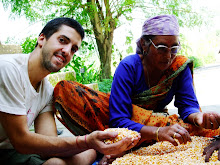


 Posts
Posts

